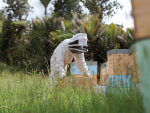
New Zealand Beekeepers Move Towards Single National Organisation
Moves are underway to create a single organisation to represent the country's beekeepers.




 increase font size
 ApiNZ chief executive Karin Kos.
On June 5, Apiculture New Zealand (ApiNZ) members will vote on the future of beekeeper representation in New Zealand.
At the ApiNZ annual general meeting (AGM) later this week, members will vote on whether the organisation will transition to a new constitution, fees structure and governance model which would take the interim name Honey and Bees NZ.
If that resolution doesn't pass, members will then be asked to approve a wind up of the lobby group's operations.
According to the Apiarist's Advocate, ApiNZ chief executive Karin Kos, who has led the organisation throughout its 11-year history, has been working alongside New Zealand Beekeeping Inc (NZBI) advisor Ian Fletcher to develop a framework for industry unification.
The work comes off the back of a series of public meetings across the country in the second half of 2025, and a smaller Industry Advisor Group in 2026.
The goal is 'unity', a key word that emerged at ApiNZ's 2025 AGM and workshop to discuss a path forward for beekeeper representation, in July 2025 in Christchurch and streamed online.
At that meeting, members voted to accept a short-term future funded largely by the Honey Industry Trust to buy time for reformation.
Prior to that, in March 2025 in the face of financial difficulties, ApiNZ’s board first proposed dissolution at an SGM, with members postponing that decision to the Christchurch AGM, and now the 2026 event.
While the proposed constitution has been developed with input from both organisations, the pathway to a full merger remains uncertain.
NZBI president Jane Lorimer says they will have to wait and see what emerges from the upcoming AGM before committing to a course of action.
That will likely involve meeting of their leadership team and then membership to confirm their contentment with a new group she says, despite Fletcher’s heavy involvement in writing the new constitution.
“We have an agreement to be part of the board to work towards the uniting of the industry, but how long that will take, I don’t know … we need to talk to our members and let them decide what we will do,” Lorimer says.
One of the most significant changes proposed under the Honey and Bees NZ constitution is a governance structure centred on commercial beekeepers.
Under the proposal, commercial beekeepers would become the primary voting members of the organisation, while non-commercial beekeepers, honey marketers, clubs and industry suppliers would be eligible for associate membership.
Associate members would have access to the organisation but would not be able to vote or hold positions on the board.
The proposed board structure would consist of between five and seven elected directors, all of whom would be required to have substantial experience in commercial beekeeping.
Directors would also have the ability to co-opt up to two non-voting members with specialist expertise.
One of the resolutions to be tabled at the AGM – should the transition to a new constitution be passed in the first vote – will be a new annual fees structure.
While they would be reduced ‘pro-rata’ for a shorter first year of operation, the proposal is for commercial beekeepers to pay $600 to become a member, plus an additional $1 per hive for any hives over 500 owned.
Among the affiliate classes are ‘non-commercial beekeeper’ whose fees would be $80 per annum, clubs $200, ‘companies involved in extraction, packing, exporting honey without beekeeping operations’ $1000, and ‘industry suppliers, research organisation etc.’ $500.
Moves are underway to create a single organisation to represent the country's beekeepers.
Not all stakeholders involved in the proposed merger of honey industry groups - ApiNZ and Unique Manuka Factor Honey Association (UMFHA) combining to form a larger organisation - think the deal is so sweet.
Bee awareness month - September - ended on a high for the struggling apiculture sector.
A plan to revitalise New Zealand’s honey sector and set it on a new, more sustainable and profitable path for the long term was launched yesterday by Agriculture Minister Todd McClay.
The recent release of the annual MPI Apiculture Monitoring Data has confirmed the impact of last summer’s wild and wet weather on the 2023 honey production season.


Decades piloting planes has ensured vet and farmer David Hayes is focused on safety. So, after a serious accident while welding on farm, he is sharing his experience so others can learn from it.

Canterbury milk processor, Synlait Milk has confirmed Leon Fung as its chief executive officer.
OPINION: Making it easier to collect rainwater and use it to grow crops and livestock is a no brainer.
As part of its Election 2026 coverage, Rural News asked political parties how they would help pull the arable sector out of the doldrums. Here's what they said:
Farmers are being encouraged to rethink how they manage waste on farm with the launch of ruralwastesorted.co.nz, a new website bringing together practical tips, real farmer experiences and resources.
New Zealand Winegrowers (NZW) is celebrating the India-New Zealand Free Trade Agreement (FTA) coming into force today, bringing New Zealand wine improved access to one of the world’s fastest-growing economies.


OPINION: The same mainstream media muppets that brought you Jacindamania in 2017 have been flat out pimping for the Opportunities…
OPINION: Your old mate reckons the atrocious way farmers in the UK are treated by their lords and masters in…




