South Island Agricultural Field Days gets new admin building
A brand-spanking new administration building will greet visitors to this year's South Island Agricultural Field Days (SIAFD) at Kirwee.




 increase font size
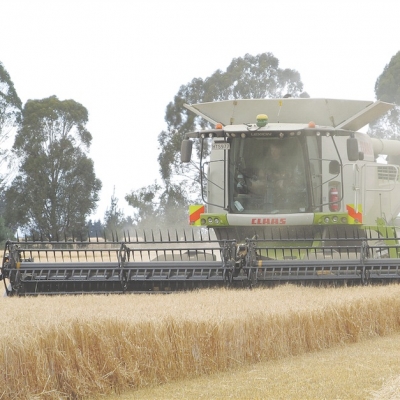 Despite the dry, harvests have been good around the country.
The South Island drought doesn’t seem to have had too much impact on crop yields to date, particularly where irrigation’s been available.
Barley sown in the autumn or winter on heavier dryland has generally come in at average or only slightly below par; where irrigated the sunny season’s seen better than average output and one, as yet unconfirmed, report of a world record.
Unsurprisingly, given the fine weather, progress is well ahead of normal with some early wheats taken already too.
“Part of the problem getting cultivar trial results is the guys have been so busy harvesting,” said FAR’s research manager cereals, Rob Craigie.
Last week he wasn’t able to relay the detail of what’s been done so far but did have some averages from sites in Canterbury. Autumn sown barley off dryland at Chertsey averaged about 8t/ha, compared to a four year mean of 8.5t/ha, while irrigated plots were in the 12-13t/ha range, suggesting an average a little over the 12.2t/ha four year mean.
Meanwhile at FAR’s St Andrews site in South Canterbury dryland barleys averaged 9.4t/ha.
“That’s pretty good for autumn sown barley and it was off a lighter soil for the area, not one of the stronger clays.”
Dryland wheat plots at St Andrews came in at a “pretty pleasing” 9.5t/ha while inland at Fairlie wheats averaged 10.5t/ha, again without irrigation.
“It will be interesting to see how yields across the district compare,” says Craigie. “If those are representative of dryland yields this year I think growers will be pretty pleased.”
Feed wheat trials at Bulls, Rangitikei, did similarly well averaging 11.4t/ha, “quite a good result” for the site. Barley there hadn’t been cut last week as it was spring sown.
Chair of Federated Farmers Grain and Seed in South Canterbury, Colin Hurst, says winter wheats in the region have done “surprisingly well” though where sowing conditions were compromised by the wet in April they’ve suffered.
“They’ve been doing 6t to 10t off dryland depending on the soil. The test weights have been good and they’ve thrashed out well.”
A big plus on his own farm at Makikihi was four days harvesting without having to dry grain. “Some farms have finished their harvest. That would be three weeks earlier than normal.”
Dryland ryegrass seed crops have “really suffered” in the dry, with yields down about 50% but autumn sown barley, like most wheats, has been good.
“Spring barley is pretty ordinary though. It’s short and the straw’s just pulverised. It’s not unexpected given the rainfall we’ve had.”
In Mid Canterbury Hurst’s Feds counterpart, Joanne Burke, says from what she’s heard barley yields off irrigated land “have held up quite nicely at 10-11t/ha” but off dryland they’ve “lost about 4t/ha” coming in at 5.5-6t/ha.
“It all depends. It’s been very patchy.”
On their own farm just inland of Rakaia dryland barley looked good but failed to deliver despite good silt loam soils.
“It had good heads on it but the grain size was horrifically small. That’s where it lost the yield.”
High winds, mostly hot norwesters with an occasional southerly cooler, did the damage, she believes.
“We had them pretty well all through December.”
Straw yields from irrigated crops have been good and with burning banned due to fire risk every bit’s been baled. Dryland straw volumes are probably half what they would be in a normal year so whether there will be more available overall compared to when some is burnt remains to be seen. One thing’s certain: it’s in demand.
“We’ve got every merchant wanting to snap up any straw they can and all the contractors are doing the same. It’s going to be an interesting situation until we can sort out what’s actually out there.”
Back in South Canterbury but off much lighter land than FAR’s St Andrews site, Peter Scott says his irrigated autumn sown barley “probably went about 8t/ha, but we put quite a bit of water on it. We went over it three times [with gun irrigators] where we’d normally only go once.”
Given the season and that his barley paddocks by Timaru airport are “some of the lightest ground in Canterbury” he said he was “pretty happy with that.”
“The key was we got it in reasonably early. If it had been a spring crop I would have expected it would do half that.”
A brand-spanking new administration building will greet visitors to this year's South Island Agricultural Field Days (SIAFD) at Kirwee.
The roads to the south have mostly reopened but the uncertainty remains for the dairy farmers of Kaikoura following the November 14 earthquake.
Generators are being organised for dairy farmers in the upper South Island so that they could milk cows, says Federated Farmers North Canterbury Dairy chairperson Michael Woodward.
DairyNZ chief executive Dr Tim Mackle says while farmers in the North Island have taken a hit from the weather, in the South Island the dairy season started well.
Southdown breeder Chris Medlicott says farmers too often focus on the price per lamb instead of the return on kilograms of dry matter eaten.


Healthy snacking company Rockit has announced Wang Yibo, one of China's most influential celebrities, as its new brand ambassador.
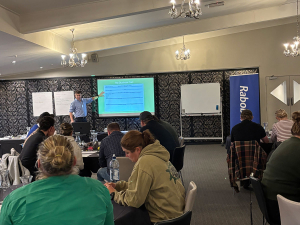
Rabobank has celebrated the tenth anniversary of its AgPathways Programme, with 23 farmers from Otago and Southland gathering for two-and-a-half days to learn new business management and planning skills.
Adopting strategies to reduce worm burden on farm goes hand-in--hand with best practice farm management practices to optimise stock production and performance, veterinarian Andrew Roe says.
Last night saw the winners of the 2026 Beef + Lamb New Zealand (B+LNZ) Awards named at a gala dinner at Te Pae Christchurch Convention Centre.
A 12-month pathway programme has helped kickstart a career in dairy for an 18-year-old student-turned-farmer.
Zespri says its global fruit sales revenue has reached a record NZ$5.9 billion from sales of 248.1 million trays.


OPINION: The old saying 'a new broom sweeps clean' doesn't always hold up, if you ask the Hound.
OPINION: This old mutt went to school to eat his lunch, but still knows the future of the country, and…