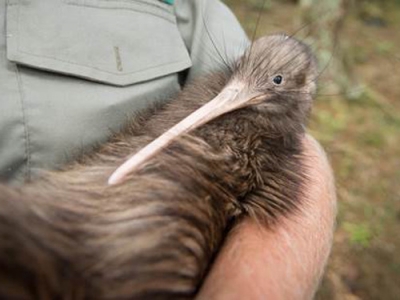
He's now completely free of his tracking device after ten years of close full time monitoring and huge breeding success.
Two Toes will retire with his "kiwi-wife" Blinky into Tanekaha's 800 hectares of predator controlled farmland, native bush and pine forest on the edge of the Hikurangi swamp.
The Tanekaha community pest controlled area (CPCA) is part of the Hikurangi Living Water catchment.
Living Water, a ten year partnership between Fonterra and the Department of Conservation (DOC), works with farmers, iwi, hapu, community groups and key stakeholders to improve the abundance and variety of native wildlife and water quality in five catchments within significant dairying regions.
In May Living Water supported the release of twelve kiwi into the Tanekaha CPCA through its regional community initiatives fund. The kiwi were moved from predator-free Motuora Island, a "kiwi crèche" in the Hauraki Gulf.
"Two Toes and Blinky have done a wonderful job," says Tanekaha CPCA Co-ordinator Edwin Smith.
"This lovely pair has greatly bolstered the local kiwi population. They've produced hatchlings three times each year since we took over monitoring from DOC five years ago."
Two Toes was originally found injured and caught in a predator trap, then rehabilitated at the Whangarei Bird Recovery Centre before his release into Tanekaha ten years ago. His injury caused him to lose one of his toes, giving him the name Two Toes.
"Now that we have nine new monitored breeding males, it's time for Two Toes to retire from monitored breeding, and for him and Blinky to live freely and safely in the area."
In the last five years Two Toes and Blinky have produced many viable eggs at Tanekaha, which have been moved for hatching at Auckland Zoo before being released on Motuora, and predator-free Matakohe/Limestone Island in Whangarei Harbour. Another three kiwi chicks have been successfully raised from the Tanekaha pair's hatchlings, to a less predator prone weight of 1.2kg, before being reintroduced to their natural habitat.
Tanekaha CPCA was launched by a group of twelve Fonterra farmers, who signed an agreement with Northland Regional Council in 2012 to establish the pest control programme. Their mission, to reduce pests and create a safe environment for kiwi to thrive in, has seen remarkable success with an intensive, and of course kiwi-safe, trapping regime.
"In the wild only five per cent of kiwi chicks survive because of predators, particularly stoats and feral cats. We're hoping for at least sixty per cent survival and these new males will attract other females so we can increase the population even further," says Edwin.
"It just shows what you can achieve with our kiwi population by tackling predators and giving these special birds a hand."
Fonterra Living Water Project Manager Tim Brandenburg says, "It's been great to work with the Tanekaha CPCA group who share the same values as Living Water. The work we're doing and the work these farmers and their community are doing shows that sustainable dairying and healthy ecosystems can exist alongside each other."
DOC ranger Rolf Fuchs organised the transfer of the kiwi from Motuora to the Tanekaha CPCA and says, "Living Water is about working together to increase the abundance of native wildlife in our catchments and supporting the habitat they need to thrive. The kiwis are safe at Tanekaha because of the great work the community is doing to control predators."
Living Water is working to improve water quality and increase the abundance and variety of native wildlife in five catchments around New Zealand.
In Northland, Living Water works in the Hikurangi catchment that feeds into the Kaipara Harbour. The other Living Water catchments are: Pūkorokoro / Miranda on the Firth of Thames/ Tīkapa Moana; Waikato peat lakes focusing on lakes Areare, Ruatuna and Rotomānuka; Te Waihora/Lake Ellesmere in Canterbury focusing on the Ararira/LII catchment; Awarua -Waituna in Southland focusing on Waituna catchment.