Efficient Irrigation Improves Pasture Productivity
Increased competition for water means the whole community is looking at how irrigators use water.




 increase font size
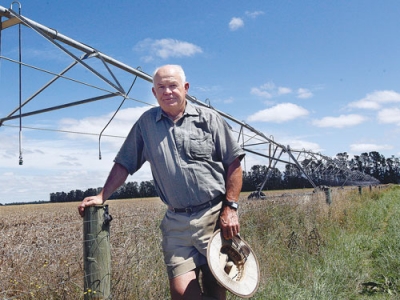 BCI scheme chair Rob McDowell.
Canterbury irrigators are shocked at Environment Canterbury's decision to stop them expanding as the regional council attempts to bring nutrient leaching under control in one of its water 'red zones'.
In announcing its decision on the Hinds water plan, Environment Canterbury (ECan) independent commissioners Peter Skelton and David Caygill have accepted Plan Change 2 to the Land and Water Regional Plan for the area of the Hinds/Hekeao Plains. This area lies north of the Rangitata River, almost to Ashburton and back west towards the Southern Alps.
This is highly productive land but the area is over-allocated for water use.
"The availability of plentiful clean water has been a critical ingredient in the catchment's economic success," says Skelton. "Water resources are now showing signs of stress, nitrogen levels are increasing and water availability is decreasing," he says. "Waterways regularly dry out in summer and aquifer levels have dropped, affecting domestic water supplies and irrigation."
Once Plan Change 2 takes effect it will prohibit further land use intensification until nitrate levels are at or below an annual shallow groundwater concentration of 6.9 milligrams/litre. Currently in the Hinds/Hekeao plains the annual average is 9mg/L.
Also announced was a decision to prevent Barrhill Chertsey Irrigation Ltd (BCI) from being granted a replacement scheme discharge permit when its current permit expires in 2018 for any land in the Hinds/Hekeao area not irrigated before February 15 2015.
This will affect the future growth of BCI in the Hinds/Hekeao area, but properties are still able to develop under the Rangitata Diversion Race Management Ltd (RDR) discharge permit until it expires in 2019.
The chairman of the BCI scheme, Rab McDowell, says BCI is seeking clarification from ECan over the decision.
"There seems to be quite a different impact on them compared to those on the RDR," he told Rural News.
"We are shocked with the outcome," says general manager of the BCI John Wright. "We're being cut out of expanding into an area where the [farmers] have put in considerable infrastructure."
Wright is meeting with ECan to see what it means overall and whether BCI are comfortable with the decision – before ruling out appealing the decision.
Applying for new water is prohibited once the plan change becomes operative, and all farming is required to be using good management practice by 2017.
Existing farming activities can increase leaching up to a maximum of 15kgN/ha/year without requiring consent. In the lower catchment (the larger proportion of the affected area) consent can be sought to increase leaching by a small amount, but this cannot exceed 20kgN/ha/year.
Properties which exceed 20kgN/ha/year in the lower catchment will be progressively required to reduce their discharge by 15% by 2025, 25% by 2030 and 36% by 2035. But they will not be required to reduce nitrogen losses below 20kg/ha/year.
The plan change also allows for existing abstractors of surface water and hydraulically connected groundwater to switch to deep groundwater, but no overall increase in water take is allowed and water surrendered must be left in the river to enable aquifer recharge.
Farmers (or any interested parties) had 15 days to lodge an appeal to the High Court on points of law only. Once appeals have been resolved the plan change will become operative.
ECan also announced it was calling for submissions on Plan Change 5 which affects land use in the Waitaki River catchment with submissions closing on March 11.
If this plan comes into effect in its current form, resource consent and audited farm environment plans will be required for farms to irrigate more than 50ha, or if they have more than 20ha for winter grazing of cattle.
Computer says no!
ECan is the first regional council bringing into play the notion of farming to industry-agreed good management practices, and is using an online portal to achieve this.
The portal, available via ECan's website, will take Overseer farm data and calculate a nitrogen baseline for individual farms, using data from 2009-2013.
Independent commissioner Peter Skelton says the idea behind using the portal is to give farmers a consistent model from which they can apply good management practices to their farms. The model can be updated as time passes without requiring changes to the plan, which are lengthy and time consuming.
"ECan won't act arbitrarily. There has been agreement between ECan and submitters on limits to changes to the portal and there are protocols in place so that farmers won't see a rapid change occurring overnight," says commissioner Caygill.
Farmers have been able to trial the portal from February 13; the Hinds/Hekeao area is the first sub-regional plan in the country to use it.
Increased competition for water means the whole community is looking at how irrigators use water.

Wallaby control efforts in Canterbury have received a major boost, with Canterbury Regional Council releasing $2 million from its Pest Management Reserve.
Newly released data from Environment Canterbury (ECan) Farm Environment Plan (FEP) audits are showing a dramatic lift in environmental performance across the region.
Buying or building a rural or semi-rural property? Make sure you know where the wastewater goes, says Environment Canterbury.
OPINION: Canterbury grows most of the country's wheat, barley and oat crops. But persistently low wheat prices, coupled with a high milk payout, are believed to be driving farmers out of the industry in the hunt for the dairy dollar, according to media reports.


An Auckland gelato shop and an established New Zealand ice cream maker have both been named Supreme Champions at the NZ Ice Cream & Gelato Awards 2026.

As the cost-of-living crisis continues to put pressure on household grocery budgets, new figures show pork remains one of the most affordable fresh meat options for New Zealand families.
OPINION: In politics, credibility is and should be big. It must surely rank higher than charisma, which is quite trite and superficial. Yet, voters nowadays are often wooed and influenced by how someone looks or talks at a superficial level. TV plays a huge role in this.
Farmers can spend less time on paperwork, thanks to a new data sharing agreement between DairyNZ’s DairyBase and LIC’s MINDA software.
Kaikōura families affected by July's severe storm have found a practical solution to a problem that's kept some children away from regular schooling for weeks: a washed-out section of Inland Kaikōura Road, which has stopped the local school bus from running its usual route.
Rural New Zealand is welcoming the Government’s recent package of rural healthcare initiatives.




OPINION: The same mainstream media muppets that brought you Jacindamania in 2017 have been flat out pimping for the Opportunities…
OPINION: Your old mate reckons the atrocious way farmers in the UK are treated by their lords and masters in…