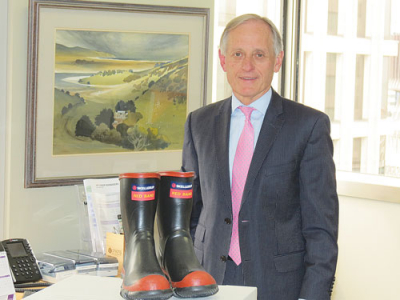
Martyn Dunne retired last week as the director-general of the Ministry for Primary Industries after five years in the role and 50 years in the public service.
Dunne spent 33 years in the army, rising to the rank of major-general, then becoming Comptroller of Customs, High Commissioner to Australia and then to his last role at MPI.
In this latter role, he dealt with many big crisises including the Fonterra botulism contamination scandal, the fruit fly incursion and most recently Mycoplasma bovis.
He told Rural News that during his time as the head of MPI the world and his organisation have undergone tremendous change.
The term ‘social licence’ has come into play and Dunne says this has affected regulators such as MPI, and producers.
“The expectations are that you can’t do what you used to without taking into account the environment, animal welfare, the progeny and the products that you produce,” he explains.
“No one will buy our stuff unless we maintain our reputation. All credit to industry -- they often get a bad rap -- but from an MPI perspective we have seen industry move light-years. Some sectors are a bit slower than others and they will catch up because people won’t buy our goods unless they know all about it.”
Dunne points to a survey of middle class people in Shanghai that showed 70% of them would buy NZ products in preference to others because of our good reputation. He says if NZ wants to continue to sell in high-value markets it must continue to meet customers’ needs.
Dunne says a classic situation where MPI had a significant role was in regard to infant formula exports to China.
“We had 176 brands going in there and the Chinese only wanted six, so we had to regulate that.”
MPI, he says, has a major role in giving customers assurance and to that end the organisation has staff in 13 NZ embassies worldwide to quickly deal with potential problems and smooth the way for new proposals.
To meet the challenges, Dunne has made some minor changes in his department, among them removing any ‘silo’ mentality and getting people to work together.
“Silos in an organisation eat it up because people are separated out and become isolated,” he says.
Engagement with stakeholders has been one of Dunne’s successes. When he spoke to Rural News just after he was appointed to MPI he stressed the need for his organisation to understand industry and for them to understand MPI.
“I realised very quickly I couldn’t get around them all so we invited key ones in to meet our senior leadership team to tell us about their strategy and let them have their say. We also continued that with our presence at events such as Fieldays,” he says.
Always seeking more advice
Much has been said about recent changes to MPI since the new government came into office.
Dunne says he is happy with the ‘portfolio’ reorganisation, which he says works. He believes if organisations are split off into small departments it has all sorts of downsides including limiting career opportunities for staff.
When he came to the role at MPI, Dunne says many media commentators kept referring to his military background and that he would be a controlling leader. However, he says that was untrue because a good military leader is a person who takes stock of a situation, seeks advice, constantly assesses a situation and only then makes a decision.
“This is exactly how we have acted with the M.bovis crisis,” he says.
He agrees that MPI may not get it right the first time every time, but he says he personally strives to put things right.
Dunne says the primary sector will have to adapt to change, with industry keeping pace with MPI and vice versa, and both will need the staff to deal with change.
He would like to see changes in education and the creation of centres of excellence to better meet the needs of the primary sector.