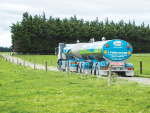
Fonterra FY26 Results: $9.69 Milk Price, $3.4bn Profit
Fonterra has unveiled its annual results for the 2026 financial year, posting $27 billion in revenue and close to $20 billion returned to New Zealand farmer owners and unit holders.




 increase font size
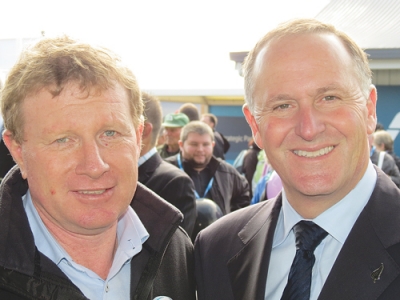 Fonterra chair John Wilson and PM John Key at Fieldays.
Fonterra is set to cut hundreds of jobs from head office as it undergoes a major review of operations.
Meanwhile, there’s not a lot of inventory of milk products globally and buyers will have to come back, says Fonterra’s chief executive Theo Spierings.
He can’t promise that will happen in the next month but it will happen at some stage, Spierings said in an interview with Radio NZ last week.
He said a business plan will go to the board this week, then to farmers. His management team is also heading an ongoing, wider business plan that will lead to “trimmed sails and an aligned crew” and “we will win this race”.
The ongoing review of Fonterra begun in December is led by Fonterra’s own talent with outside consultants with a global view, he said.
Fonterra needs more people selling in market and fewer people in support and group functions. That would have “consequences” but was part of trimming the sails.
Spierings was asked whether the co-op’s marketing took full advantage of the appeal of New Zealand’s pasture based systems. He said Fonterra’s milk commands a 20-30% premium in markets because of its appeal, but more of that is needed.
Spierings says the co-op’s review is looking at everything. In the last four years Fonterra has increased it milk production by 22%, 80% of which came from within New Zealand and 20% from outside. Fonterra had a 10-12% return on capital from its global business; if it could run that at 13% it would have a very strong performing business.
Spierings was questioned on whether farmers were pushed too hard to boost production, raising their cost structure, and whether the focus should have been on value added premium products.
But Spierings said they require scale to “have a ticket to the game”. Volume and value must both be boosted.
In this financial year 26% of milksolids were sold on GDT, an increase of 40%; that should lead to a stronger milk price, he said. However China was playing a waiting game, Russia was locked up and the Middle East had geopolitical troubles. Fonterra needs a clear eye and view of the markets because change in Russia or the Middle East can have a big impact, as can weather in production regions.
While he was concerned about demand, Spierings said Europe’s production had only increased about 1% since quotas were lifted and the US was scaling down.
“There’s not a lot of inventory around. People have to come back… the demand will come back. I am not going to say it will lift in the next month but it will come back.”
Meanwhile all the cash Fonterra can find will be assigned to the balance sheet and hopefully will end up in farmers’ hands, Spierings said.
Fonterra has unveiled its annual results for the 2026 financial year, posting $27 billion in revenue and close to $20 billion returned to New Zealand farmer owners and unit holders.
Fonterra Co-operative Group has confirmed the independently assessed candidates standing for election to its board in 2026.
Fonterra has revised its Farmgate Milk Price forecast for the 2026/27 season, lifting the midpoint and narrowing the range on the back of improving global dairy commodity prices.
Outgoing Fonterra Co-operative Council chair John Stevenson says that it has been a privilege to represent the co-op's farmer shareholders.
OPINION: It seems Canterbury processor Synlait is still in the doldrums.



Federated Farmers says it welcomes Labour's commitment to reviewing the Sharemilking Agreements Act, calling on other major parties to do the same.
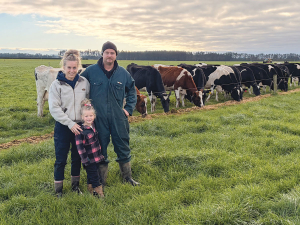
For Canterbury dairy farmers Sian Meijer and Rick Wobben, wearable technology has become one of their most valuable on-farm tools - helping manage 1850 cows across an expansive, high-performing dairy operation while improving efficiency, mating outcomes and day-to-day decision making.
Fonterra has unveiled its annual results for the 2026 financial year, posting $27 billion in revenue and close to $20 billion returned to New Zealand farmer owners and unit holders.
The first major update to the Dairy Cattle Code of Welfare in more than a decade has been released, marking what DairyNZ describes as an important step in ensuring animal welfare standards continue to evolve alongside scientific evidence and on-farm realities.
Ravensdown shareholders have elected Jane Montgomery and Kate Acland to the Ravensdown Board for three-year terms, following a closely contested director election.
Federated Farmers says new legislation replacing the Resource Management Act will cut red tape, unlock investment and help grow New Zealand's export-led economy, after the Planning Bill and Natural Environment Bill passed their third reading in Parliament yesterday.




OPINION: The same mainstream media muppets that brought you Jacindamania in 2017 have been flat out pimping for the Opportunities…
OPINION: Your old mate reckons the atrocious way farmers in the UK are treated by their lords and masters in…




