NZKGI Responds to Migrant Worker Exploitation Reports
Where any worker in the kiwifruit industry is mistreated, we expect the authorities to take action.




 increase font size
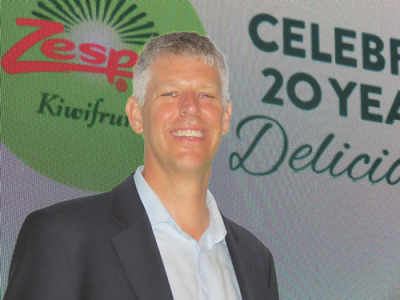 Lain Jager.
Zespri chief executive Lain Jager has warned against getting carried away with the current good times in the kiwifruit sector.
Speaking to Rural News at a conference celebrating 20 years since the Zespri brand was introduced, Jager said the industry has enjoyed much success and tremendous growth, especially during the last two years. But he warns that people need to be careful that this positivity doesn’t translate into reduced resilience.
Jager says the NZ kiwifruit industry recorded 22% growth in 2015 and 16% in 2016; in 2017 there’s been a slight contraction in volume due to seasonal factors
“Beyond the seasonal factors, the deeper question is ‘what is a sustainable rate of growth?’ What we are doing is licensing gold kiwifruit at 400ha or seven million trays a year,” he explains.
“We believe seven million trays in the gold business is sustainable each year and will give us a very stable green business. Most important for us is to keep an eye on how much gold kiwifruit we licence and at what rate. This is a decision we will only finalise after each season ends – when we know if the demand growth is consistent with supply growth.”
The strong growth in the kiwifruit industry has meant greater capital investment and, with it, debt levels creeping up. Jager says the industry needs to keep an eye out for external shocks, which could come from US President Trump’s anti-trade policy and changes in currency values.
“The primary industry almost has a tradition whereby bust follows boom. It happened in the dairy industry and we are conscious of that and we are vulnerable to it,” Jager says. “There is a need for us to keep an eye on what’s happening with international trade and international relationships.”
Jager says recent political events have produced unexpected results and there is now a heightened sensitivity to global events. He says Zespri has a wonderful open dialogue with government and business and he believes the government is aware of the issues and is acting accordingly to protect NZ’s interests.
But he warns that growers can’t sit back and leave it to the politicians to solve.
“At the end of the day, our growers are exporters and they need to configure their businesses for the global risks they face,” Jager says.
While much of the conference was pitched at celebrating Zespri’s success, many of the keynote speakers including bankers, futurists and marketers warned on the challenges all food producers face.
Many noted the demands of high-end consumers who want to know that the food they are eating is not only healthy and safe, but also sustainably produced.
Jager says taste, health and convenience pose a challenge. But the secret lies in Zespri’s ability to innovate faster than the competition.
Where any worker in the kiwifruit industry is mistreated, we expect the authorities to take action.

Kiwifruit growers are watchful but remain optimistic as concerns around the potential effects of the El Niño weather pattern this season.
More signs of a booming kiwifruit sector.
After delivering a strong financial year, rural trader PGG Wrightson says the coming months will depend on customer confidence and weather.
New Zealand growers have always adapted to changing conditions, but one challenge is steadily gaining ground across the horticulture sector: resistance.


Synlait has swung to second-half profit as operations stabilise, but the dairy processor still posted a $75.4m annual loss.

LIC shareholders have elected a new North Island representative to the co-operative's Board, along with five representatives to its Shareholder Reference Group (SRG), following the company's Annual Meeting held in Invercargill.
Farmers across parts of Southland and South Otago are continuing to deal with difficult conditions after a prolonged run of wet weather, with pressure building around feed supply, stock management, pasture damage, farm infrastructure and everyday workloads.
Federated Farmers says it welcomes Labour's commitment to reviewing the Sharemilking Agreements Act, calling on other major parties to do the same.
For Canterbury dairy farmers Sian Meijer and Rick Wobben, wearable technology has become one of their most valuable on-farm tools - helping manage 1850 cows across an expansive, high-performing dairy operation while improving efficiency, mating outcomes and day-to-day decision making.
Fonterra has unveiled its annual results for the 2026 financial year, posting $27 billion in revenue and close to $20 billion returned to New Zealand farmer owners and unit holders.




OPINION: The same mainstream media muppets that brought you Jacindamania in 2017 have been flat out pimping for the Opportunities…
OPINION: Your old mate reckons the atrocious way farmers in the UK are treated by their lords and masters in…




