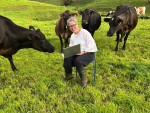
International Day of Rural Women: Two DairyNZ Farmers’ Stories
Today, 15 October, is the International Day of Rural Women, which recognises rural women’s contribution to farming, communities and the environment.




 increase font size
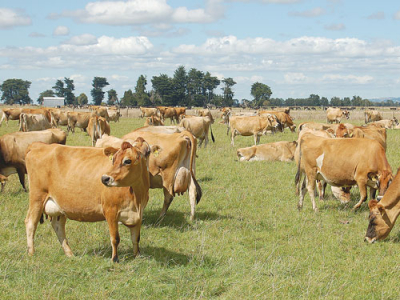 Jersey cows produce more fat than other breeds.
Milk fat will earn dairy farmers more than protein in the 2018-19 season.
Fat has been a low-value milk component, but has risen steadily in recent seasons due to consumer-driven market value, says DairyNZ strategy and investment leader Bruce Thorrold.
“That’s a welcome change for NZ dairy farmers who are set to receive a strong 2018-19 milk price buoyed by the value of milk fat,” he says.
In the 2009-10 season, milk fat earned only one-third of a dairy farmer’s milk income. Between 2010 and 2015, the five years prior to the current surge in fat value, milk fat earned 38% of the farmer’s milk income.
Today, Fonterra is paying almost parity. Next season a kg of fat will be earning suppliers much more than a kg of protein.
Since Jersey cows produce more fat than any other breed, the breeding worth (BW) of Jersey bulls is growing.
Milk price and the relative value of fat and protein are the biggest factors in the BW of dairy cattle.
The changes in fat price have caused large shifts in BW between and within breeds. Of the top 200 bulls by BW in 2019 (BW2019), 70% are Jersey, 5% Holstein-Friesian and 25% cross-bred (Jersey and Holstein Friesian), Thorrold says.
“On average, Jersey bulls are increasing by $23 BW while Holstein-Friesian decrease by $28 BW. Cross-bred and Ayrshire bulls are relatively unchanged (-$4 and -$3 BW). Within breeds, individual bulls will shift up or down by as much as $40 BW relative to their breed average shift.”
NZ Animal Evaluation (NZAEL), a wholly owned subsidiary of DairyNZ, administers a BW index to rank cows and bulls according to their ability to meet the national breeding objective of breeding dairy cows that will be the most efficient converters of feed into profit for farmers.
NZAEL recently finalised the economic factors that will be used to calculate BW from February 2019, Thorrold says.
“This will give farmers insights into which bulls can add the most value to their breeding programme in a market where fat is a high-value component. The calves born in spring 2019 will have the BW2019 values.”
The economic values of fat and protein are calculated by partitioning the milk solids price into a value for fat and protein, then accounting for the cost of producing each component. The value of fat relative to protein has been increasing for the past three seasons and this trend is forecast to continue.
NZ is well placed to benefit from strong demand for fat-based milk products due to the strong influence of Jersey genes in the national herd. There is high genetic variation in the trait in NZ dairy cattle that enables farmers to respond quickly to market signals.
Today, 15 October, is the International Day of Rural Women, which recognises rural women’s contribution to farming, communities and the environment.
The first major update to the Dairy Cattle Code of Welfare in more than a decade has been released, marking what DairyNZ describes as an important step in ensuring animal welfare standards continue to evolve alongside scientific evidence and on-farm realities.
Have a plan in place for your cows and staff.
DairyNZ deputy chair Cameron Henderson has been re-appointed unopposed for another term.
OPINION: The stats speak for themselves.


Federated Farmers has welcomed new rural policies released by ACT, saying they align closely with its own election priorities.

Rural Contractors NZ says proposed changes to land transport rules for agricultural vehicles are a welcome response by the Government to out of date regulations which have seen members hit with huge fines.
Alliance is calling for final applications for its 2027 Graduate Programme, with applications closing on Sunday 25 October.
Decades piloting planes has ensured vet and farmer David Hayes is focused on safety. So, after a serious accident while welding on farm, he is sharing his experience so others can learn from it.
Canterbury milk processor, Synlait Milk has confirmed Leon Fung as its chief executive officer.
OPINION: Making it easier to collect rainwater and use it to grow crops and livestock is a no brainer.


OPINION: The same mainstream media muppets that brought you Jacindamania in 2017 have been flat out pimping for the Opportunities…
OPINION: Your old mate reckons the atrocious way farmers in the UK are treated by their lords and masters in…




