
Beef + Lamb New Zealand Awards 2026 Winners Announced in Christchurch
Last night saw the winners of the 2026 Beef + Lamb New Zealand (B+LNZ) Awards named at a gala dinner at Te Pae Christchurch Convention Centre.




 increase font size
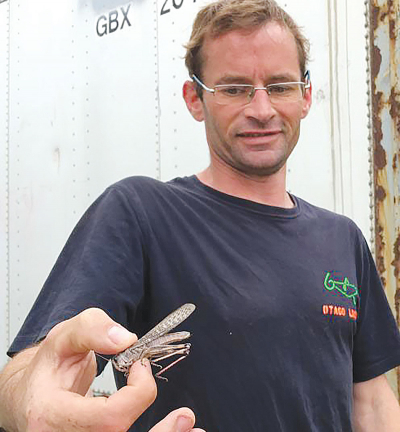 Malcolm Diack with one of his locusts at his farm overlooking South Dunedin. Photo: SUPPLIED.
An AgResearch survey which found most New Zealanders would try eating insects does not surprise the country’s first locust farmer.
Malcolm Diack runs his business, Otago Locusts, out of two shipping containers on his residential property at Lookout Point, Dunedin city.
Diack first farmed locusts as feed for frogs which he rears as a hobby. Discovering he was good at it, he won certification three years ago to farm them for human consumption.
He says while it was hard to guess “who’s up for it and who’s not,” the AgResearch finding is in line with other researchers and his own experience in trying to get people to eat insects.
“It’s that first one,” Diack told Rural News. “Once you’ve eaten that first one you’re away.”
Diack feeds his locusts on fresh grass harvested mostly from public reserves and verges in and around Dunedin and out onto the Taieri Plain, avoiding areas perhaps sprayed.
Locust numbers vary with the time of year, but when running at “full speed” he says 8-10kg of fresh grass a week produces 3-4kg of locusts.
Diack sells the locusts live, delivered by overnight courier. Customers include restaurants. He also sells some as animal feed to zoos.
He concedes it’s “slightly intimidating” for the public to receive live locusts which they must kill themselves by freezing, rather than something processed and ready for use.
However, he has experimented with dehydrating and grinding them into a flour. Baked into brownies and tested on friends and family it “went gangbusters,” he claims.
“No-one knew the difference and was happy to eat them.”
Diack has also experimented with locusts covered in chocolate or embedded in lollipops.
“That’s where we’re heading in the last half of this year, to make some foods that we can package and sell -- processed food rather than just live locusts.”
While insect protein is billed by some as a way to save the world, Diack doesn’t see himself as an environmental crusader. However, he is aiming for maximum environmental sustainability, using solar power, a dehydrator to capture and recycle water, and trying to re-use greenhouse gases and the locust droppings as fertiliser.
“I’m doing it because I love animals and insects and I work well with them,” he said.
Would you?
In the AgResearch survey of 1300 people self-selected through Facebook, 67% said they were likely or very likely to try insects as powder or flour baked into other goods.
Over half (55.6%) said they would likely consume fried insects.
Asked to rate their interest in eating native species, participants said they were more likely to eat black field cricket nymphs and locust nymphs, followed by mānuka beetle and then huhu beetle grubs – suggesting a clear preference for crunchy rather than “squishy” insects.
AgResearch social scientist Penny Payne, who ran the survey, says the three most referenced factors are texture, “disgust” then taste. That differed from previous studies where disgust was ranked top.
While insects are an excellent source of protein and healthy fats, with high levels of vitamins, minerals and essential amino acids, they are seen as inappropriate or unappealing in Western societies.
Payne says the reasons are culturally and socially complex, notably psychological barriers such as disgust toward insects as food, poor presentation of insects as an appealing food choice, and lack of familiarity.
“In particular, in most Western countries people may associate insects with connotations of pests and disease transmission, due to this being the most common way they are portrayed.”
However, 60% thought that eating insects would be a more environmentally sustainable option than eating beef, lamb, pork and chicken from traditional New Zealand farms.
Meanwhile, Payne herself was trying out cookies on her Ruakura colleagues, made with about 3% cricket flour, which she said gave a nutty and earthy flavour.
“I should’ve put more in actually. I’ve made them a few times and I put more in last time and they were more nutty and flavourful.”
She says the texture was interesting -- “a little bit gritty once you get the legs in there”.
Last night saw the winners of the 2026 Beef + Lamb New Zealand (B+LNZ) Awards named at a gala dinner at Te Pae Christchurch Convention Centre.
A significant breakthrough in understanding facial eczema (FE) in livestock brings New Zealand closer to reducing the disease’s devastating impact on farmers, animals, and rural communities.
A breakthrough in the understanding of Facial Eczema (FE) in livestock could bring New Zealand closer to reducing the disease’s impact.
An innovative idea for transforming mechanically deboned meat (MDM) into a meat flake for seasoning has taken top honours in the Meat Industry Association’s (MIA) first-ever Dragon’s Den competition.
The Government's plan to merge the seven crown institutes presents exciting possibilities for plant technology company Grasslanz Technology, says chief executive Megan Skiffington.



Celebrating 50 years in the rural landscape of Central Canterbury and beyond, Ashburton-based Carrfields, has been the exemplar for all aspects of modern agriculture via its extensive range of services including supply, growing, agronomic advice and marketing.
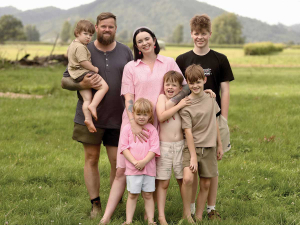
For Taupiri dairy farmers Logan and Sian Dawson, their involvement in the NZ Dairy Industry Awards has been a key catalyst in the growth of their business - the experience helping shape how they approach the farm ownership pathway they are pursuing today.
West Otago dairy farmer Luke Kane has been awarded the 2026 Rabobank Dr John Morris Business Development Prize.
OPINION: As the general election approaches, political parties are churning out policies in the hope of attracting more votes.
An LIC bull, Tronnoco AR Sadio-ET S3F, bred by Tony and Keri O'Connor of Tronnoco Farming Co Ltd near Timaru, has won the 2026 Mahoe Trophy.
With forecasters advising El Niño conditions will develop through winter and strengthen into spring and summer, Ballance Agri-Nutrients is encouraging farmers and growers to think ahead about nutrient planning and be prepared to work around challenging weather conditions.





OPINION: The same mainstream media muppets that brought you Jacindamania in 2017 have been flat out pimping for the Opportunities…
OPINION: Your old mate reckons the atrocious way farmers in the UK are treated by their lords and masters in…