
Lanaco and Blueair Launch World-First NZ Wool Air Filter
New Zealand wool is reaching new heights as air filtration companies move away from synthetic products to biodegradable alternatives.




 increase font size
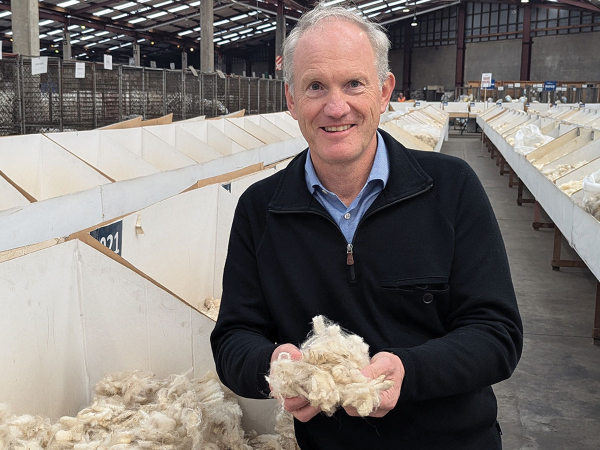 Wool Impact CEO Andy Caughey inspects a sample of strong wool at the PGW auction rooms in Christchurch.
The recently signed free trade agreement with India is an invitation to strengthen relationships between the New Zealand and Indian strong wool industries, says Wool Impact chief executive Andy Caughey.
Among other measures, the FTA removes India's 2.75% tariff on New Zealand wool imports.
"The value of that is small but it's the administrative burden," said Caughey.
"I think the removal of it is an invitation for closeer relationship building, for collaboration and working together."
Caughey recently hosted a delegation representing five wool processing companies based in Bikaner, Rajasthan, India's leading wool manufacturing city.
As the inbound delegation since the FTA was signed, they met Trade Minister Todd McClay in Wellington a month to the day after the signing.
They also visited a sheep farm and attended a national wool auction at the PGGW auction rooms in Christchurch.
The delegation was led by Dhiraj Bilandani, the India-based CEO of NZ Wool Services International Ltd, a wool import/export and marketing company with offices also in New Zealand and China.
Bilandani said the visitors were all very big consumers of New Zealand wool.
"So, they're very dear clients to us and it's our aim to show them the industry, to familiarise them with the processes here - scouring, auction, shearing and everything.
"It's a learning experience for them; it will give them more confidence and more connect to buy more from us and increase their trade."
Bilandani said the FTA was something they had been looking forward to for some time.
"Now, the duty of 2.75% will be waived off so the exports will be more seamless. And it will encourage the buying of New Zealand wool further for the Indian market."
Caughey said that about 70% of the New Zealand wool that goes to India goes through Bikaner, where it is blended, dyed and spun into yarn.
Much of it then goes on to Bhadohi in Uttar Pradesh, which is dubbed the "Carpet City of India", being the largest hub for the hand-knotted carpet and rug weaving in South Asia.
Caughey said India was the second largest buyer of wool from New Zealand after China but it was rapidly growing.
"In the last two years, they've purchased around $77 million worth of wool a year and it's growing in importance."
He said India would become an even more important market because of Prime Minister Narendra Modi's 'Pathway to Prosperity' vision that aims to transform the nation through structural reforms and technological self-reliance to boost infrastructure and elevate the standard of living.
India had a huge amount of inherent capability with about 45 million people employed in textiles and about 100 million in agriculture.
"But they're looking at doubling the number of people in textiles and fashion to around 90 to 100 million.
"It's building vertical capability to sell to the world."
Caughey said many of the delegation represented family-run companies.
Their fathers and grandfathers had been buying New Zealand wool for five or six decades, and some had themselves been buying for 25 or 30 years but had never been to New Zealand.
He said it was important for them to see and experience our systems of farming, animal welfare, environmental care and attention, "and just green grass".
Their levels of understanding and appreciation of our systems had significantly changed during their visit.
New Zealand wool is reaching new heights as air filtration companies move away from synthetic products to biodegradable alternatives.
Will a stronger, more coordinated voice help rebuild confidence and improve returns in the wool sector?
OPINION: Confidence in the wool sector is rebounding as prices hit levels not seen in more than 15 years.
Rising strong wool prices are finally returning the sector to profitability.
Strong competition and tightening supply have seen wool reach its highest prices paid at auction since 2011.


Minister of Conservation Hon Tama Potaka has appointed Susan O'Regan as Chair of the Queen Elizabeth II National Trust (QEII) for a three-year term.
Red meat farmers are welcoming Labour’s plan to review the Emissions Trading Scheme and not to campaign on pricing agricultural emissions.
Where any worker in the kiwifruit industry is mistreated, we expect the authorities to take action.
Mid Canterbury Federated Farmers arable chair, Bevan Lill, said Beef + Lamb NZ data indicated that for the last six years, the average arable return on investment was about 0.8% while inflation ran about 4% - so the average arable farm was going backwards at about 3% a year.
Seed and grain companies share the concerns of arable farmers about the viability of their sector, says Seed and Grain New Zealand chief executive Dr Sarah Clark.
The New Zealand Institute of Forestry (NZIF) says unnecessary changes to New Zealand’s Emissions Trading Scheme (NZ ETS) will seriously erode investor confidence and result in significant reductions in forest planting rates.

OPINION: The same mainstream media muppets that brought you Jacindamania in 2017 have been flat out pimping for the Opportunities…
OPINION: Your old mate reckons the atrocious way farmers in the UK are treated by their lords and masters in…




