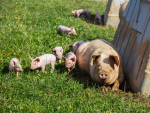
Hungry Kiwis pig out on free NZ pork during lockdown
NZ Pork is hailing the success of a scheme where the Government bought surplus pork and had it delivered to food banks to counter the disruptions of the Covid-19 pandemic.




 increase font size
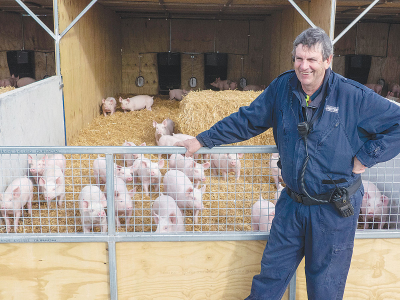 Christchurch Men’s Prison farm chief instructor Warren Chilton with fattening pigs on one of the farm’s Freedom Farms-certified straw barns. Photo: Rural News Group.
Suggest to farm manager Warren Chilton that he is farming people as much as he is farming animals and he readily agrees.
Chilton is the principal instructor at the Christchurch Men’s Prison farm, 804ha of mixed livestock and cropping surrounding the prison on the western outskirts of the city.
The jewel in the farm’s crown is its 8000-strong piggery. And it runs 2000 breeding ewes, about 250 beef cows and grows about 100ha of barley.
Also on site is a woodwork shop, so altogether there could be up to 40 low security prisoners “outside the wire” on any given day, training in the skills they will need on release.
“We are here basically for rehabilitation of prisoners, to give them work skills, work ethics, get them work ready and hopefully find jobs for them. That’s our main focus,” Chilton told Rural News.
The farm runs on a commercial basis so the prisoners get no surprises when they go into industry, he says.
The prisoners also receive classroom training and work towards NZQA qualifications, with modules on quad and tractor handling, chemicals handling, shearing, drilling and fencing.
About 60% of prisoners are effectively illiterate so literacy and numeracy are embedded in the training.
The farm was set up at least 100 years ago to feed the inmates. As it moved towards more commercial farming, the piggery was set up because the prison needed an industry that was labour intensive and suited to its light, free draining soil.
The piggery is now the major part of the farm. It runs 600 breeding sows, 66 boars as AI backup and 7000 growing pigs. Chilton describes the piggery as a “farrow to finish” operation, selling 17,000 animals to slaughter each year.
Ironically, for an operation where human prisoners provide the labour, the piggery’s products are sold NZ-wide under the Freedom Farm brand. The brand certification requires a range of strict animal welfare standards that start with no confining crates or concrete fattening pens.
Sows live outdoors, each with her own farrowing hut set in a small paddock separated from her sisters by electric fencing. The farm’s pigs also have wallows protected by shade cloths during summer.
Litters stay with their mothers until weaning when they start rotation through a series of light, airy barns with straw or woodchip floors. The pigs are free to wander with 24 hour access to food and water and are able to display normal behaviours in social groups.
“We get a premium for our product because that’s what customers want now,” Chilton said. “They want to know where their pigs have come from and that they’ve been treated nicely.
‘They’re not lying in crates and stalls and things like that.”
The piggery runs year round to a weekly rhythm. AI is done on Tuesdays and Wednesdays.
Weaners are taken from the sows on Thursdays, at an average age of 26.5 days and 8kg in weight. They are then reared through a series of eco-barns and micro-barns before going to slaughter at 138 days and 70kg dressed weight. About 100 go on Sundays, and 200 on Wednesdays. The farm also sells about 20 smaller spit pigs a week.
With two main sources of pig semen in New Zealand, the farm uses Waratah Farms semen for their replacement dam line and PIC New Zealand semen for the sire line. Chilton says this combines the best from both companies.
“It’s really changed the efficiency and performance of our pigs. They’re growing faster and leaner,” he says. “If you don’t keep improving all the time you’ll get left behind.”
NZ Pork is hailing the success of a scheme where the Government bought surplus pork and had it delivered to food banks to counter the disruptions of the Covid-19 pandemic.
Pig farmers have joined a growing chorus in the primary sector calling on the Government to urgently review its migrant worker policies in the wake of Covid-19.
Scientists are calling for urgent action following the discovery of a new strain of swine flu.
US pig farmers could soon be culling on-site due to a COVID-19 induced backup at meatpacking plants.
Award-winning pig farmer Patoa Farms likely have the only Valtra S394 tractor in New Zealand — but that may soon change given its many benefits.



Alliance is calling for final applications for its 2027 Graduate Programme, with applications closing on Sunday 25 October.
Decades piloting planes has ensured vet and farmer David Hayes is focused on safety. So, after a serious accident while welding on farm, he is sharing his experience so others can learn from it.
Canterbury milk processor, Synlait Milk has confirmed Leon Fung as its chief executive officer.
OPINION: Making it easier to collect rainwater and use it to grow crops and livestock is a no brainer.
As part of its Election 2026 coverage, Rural News asked political parties how they would help pull the arable sector out of the doldrums. Here's what they said:
Farmers are being encouraged to rethink how they manage waste on farm with the launch of ruralwastesorted.co.nz, a new website bringing together practical tips, real farmer experiences and resources.


OPINION: The same mainstream media muppets that brought you Jacindamania in 2017 have been flat out pimping for the Opportunities…
OPINION: Your old mate reckons the atrocious way farmers in the UK are treated by their lords and masters in…




