NZ kiwifruit sector on alert for mysterious Italian disease
New Zealand's kiwifruit industry is on alert following reports of a mystery disease that is sweeping through Italian orchards.




 increase font size
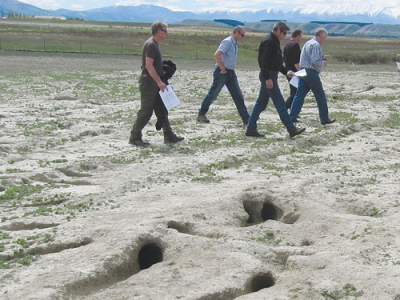 Rabbit damage on farmland near Dunstan, Central Otago. Photo: Bob Douglas.
The planned release of a new strain of the rabbit calicivirus appears back on track for next autumn after missing a previous opportunity.
The New Zealand Rabbit Coordination Group (RCG) had hoped to release the new strain this year, at the same time as an Australian release, but could not complete a complicated approvals process in time.
However, the new strain still needs approval by the Ministry for Primary Industries under the Agricultural Chemicals and Veterinary Medicines (ACVM) Act 1997 and the Biosecurity Act 1993.
Environment Canterbury, managing the approval process for the RCG, has applied to MPI for those approvals and MPI has called for public submissions, closing on December 14.
MPI says before it will register the new strain it will consider the benefits of the release to the agricultural sector, and risks to animal welfare, farming, trade and public health.
“This includes the risk to pet and farmed rabbits and the availability of protection by a vaccine.”
Calicivirus (RHDV1) causes a fatal rabbit haemorrhagic disease. It is widespread in New Zealand after its unapproved release in 1997, but has lost efficacy after the initial spread and rabbit numbers have recovered in many areas. The new variant, RHDV1 K5, is a Korean strain believed better at overcoming the protective effects of a benign calicivirus which occurs naturally in feral rabbits and gives some immunity.
Graham Sullivan, ECan regional leader biosecurity, says that when this year’s hoped-for release was shelved it was considered important to delay the release to next autumn -- the time of greatest effectiveness. During autumn there are no naturally immune newborn rabbits, and carrot bait is then most attractive and it lasts better on the ground. Then also, UV light, which affects the virus’s efficacy, is lower.
The RCG includes representatives from regional and district councils, Federated Farmers, the Department of Conservation, the Ministry for Primary Industries and Land Information New Zealand. The release of the new strain is expected to be managed by the territorial authorities.
New Zealand's kiwifruit industry is on alert following reports of a mystery disease that is sweeping through Italian orchards.

Could automated gun turrets in the bush shooting predators with poison paintballs rid the country of introduced pests?
As mealybugs gain a foothold in Central Otago, grapegrowers are being urged to be vigilant for signs of Grapevine Leafroll-associated Virus Type 3 (leafroll 3) in vines.
An invasive weed that can reduce water quality and block irrigation systems has been discovered in the Waikato River.
For strong wool sheep, lice infection is a nuisance more than a hefty financial cost. But, for fine wool sheep the financial toll is much greater.

Penske Australia & New Zealand has appointed Stephen Kelly as the general manager of its Penske NZ operations, effective immediately In this role he will oversee all NZ branch operations, including energy solutions, mining, commercial vehicles, defence, marine, and rail, while continuing to be based at Penske’s Christchurch branch.
According to the latest Federated Farmers-Rabobank Farm Remuneration Report, released today, farm worker pay growth has levelled off after a post-Covid period of rapid growth.
The Climate Change Commission has recommended maintaining the current New Zealand Emissions Trading System (NZ ETS) settings but warns of a potential unit shortfall as early as 2028.
The Conservative Party warns that the upcoming free trade agreement between New Zealand and India may prioritise increased labour mobility while offering limited reassurance for New Zealand workers.
Southland District Council says it is actively managing the impacts of the current fuel supply challenges to ensure essential services across the district continue to operate safely and reliably.
A large crowd turned out for the last of the field days of the three finalists in this years Ahuwhenua Trophy to determine the top Maori horticulture entity in Aotearoa New Zealand


OPINION: When Donald Trump returned to the White House, many people with half a brain could see the results for…
OPINION: Media trust has tanked because of what media's more woke members do and say.