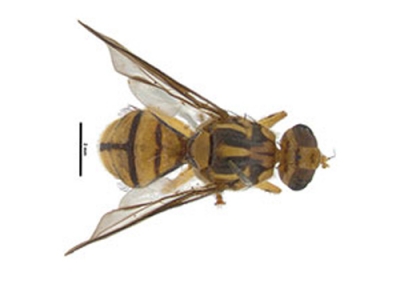
A single Tau fly has been found in surveillance traps in South Auckland and is under investigation by the Ministry for Primary Industries (MPI).
The tropical fly represents a biosecurity threat to some horticultural crops, but not the significant threat posed by Queensland fruit fly.
The fly was found in the Auckland suburb of Manurewa. It was collected from a trap in the afternoon of Thursday, January 21 and it was formally identified later that day.
MPI's manager surveillance and incursion investigation, Brendan Gould, says only the one fly has been trapped and this does not mean New Zealand has an outbreak of the Tau fly.
"We have a significant number of traps in this area which were all checked yesterday. No other flies were found," he says. "This fly is a species normally found in South East and Southern Asia and is used to a more tropical climate. It's very unlikely to be able to establish in New Zealand."
Gould says MPI has responded swiftly. "We have teams in the field now setting additional traps to determine if other flies are in the area, and they will take actions to prevent spread out of the area if more flies are found.
"It is vital to find out if this fly is a solitary find or if there is a wider population in Auckland.
"Unlike the Queensland fruit fly this insect has a much more limited range of host material and has a preference for cucumbers, pumpkins and zucchini. Though capsicum, beans, passionfruit and melons are minor hosts.
"We're not treating this lightly. While the Tau fly is a threat, it's not as widely damaging as the Queensland Fruit Fly.
MPI has placed controls on the movement of certain fruit and vegetables in a defined circular area extending 1.5km from where the fly was trapped in Manurewa.
Detailed maps of the controlled area and a full description of the boundaries, and full information about the rules are on www.mpi.govt.nz/tau-fly.
Pumpkin, melon, cucumber, capsicum, zucchini, beans and passionfruit plants and fruit cannot be moved outside of the Controlled Area.
"These controls are an important precaution while we investigate whether there are any further flies present," Mr Gould says.
The most likely way these flies can arrive in New Zealand is in fresh fruit and vegetables.