
Fonterra CFO Andrew Murray Resigns
Fonterra Co-operative Group chief financial officer Andrew Murray has resigned to take up a role outside the dairy giant.




 increase font size
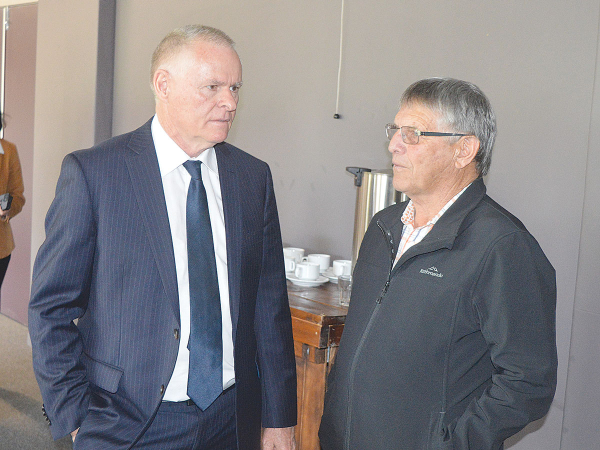 Fonterra chair Peter McBride in discussions with Dunsandel farmer Murray Marshall.
After years of average or below-average returns, Fonterra unit holders received a record dividend in 2023.
An annual dividend of 50c/share, topped up by a 50c/share capital return in October, took the total cash distribution to $1/unit for the 2023 financial year.
Fonterra Shareholders Fund (FSF) Mary Jane (MJ) Daly told its recent annual meeting she was under no illusion that the historical performance of the fund has not been satisfactory for unit holders.
"However, it is pleasing to see Fonterra's continued focus on its strategy is delivering value, and this has been reflected in the total shareholder return since the last annual meeting in November 2022," she says.
FSF unit holders enjoyed a 36.5% return, compared to 23.6% return for Fonterra shareholders.
In 2022 and 2021, Fonterra unit holders received total dividend of 20c respectively. However, in 2019, Fonterra made a loss of $605 million and paid no dividend. The following year it paid 5c in dividend.
Fonterra units have had a rollercoaster ride on NZX. Over the past two years, it peaked at $3.85 in December 2021 before plunging to $2.75 four months later. Three months ago, the unit price again topped $3.85 before dropping to $3.15 last week. Unit holders get a dividend based on the co-op's value-added business but have no voting rights. Daly says the fund board has seen several positive steps by Fonterra over the past 12 months, "that demonstrated the greater alignment between unit holders and shareholders' interests under Fonterra's new flexible shareholding capital structure".
This includes Fonterra's transparency on its resource allocation framework, focusing on disciplined allocation of milk and financial resources, and senior management being aligned to the delivery of value to shareholders and unit holders.
Fonterra chair Peter McBride told the meeting that the co-op's flexible shareholding capital structure has been in place since March this year and is working broadly as expected.
He noted the new structure was designed to give all shareholders a degree of choice with their shareholding, rather than the old model which was one of compulsion.
"With farmers now having the flexibility to, at the top end, hold up to four times their milk supply, or at the bottom end hold as little as the equivalent of 33% of their milk supply, there is a significant level of discretion in their investment choices - akin to the choice you have as unit holders."
McBride noted that the number of discretionary shares in the co-op has increased from around 250 million under the previous Trading Among Farmers structure, to 1.2 billion discretionary shares under the new structure.
Fonterra Co-operative Group chief financial officer Andrew Murray has resigned to take up a role outside the dairy giant.

Four candidates have been confirmed for two director positions on Fonterra’s board.
A record farmgate milk price and strong global demand is laying the foundation for continued growth of organic dairy farming in New Zealand.
Waikato milk processor Tatua has again declared a record milk payout to farmer shareholders, leaving other processors in the dust.
Fonterra has unveiled its annual results for the 2026 financial year, posting $27 billion in revenue and close to $20 billion returned to New Zealand farmer owners and unit holders.


National’s pledge to introduce 19 new national standards shows the party is serious about getting Wellington out of farming, Federated Farmers says.
The National Party’s policies to make it easier to grow fresh vegetables, secure reliable water and energy and simplify farm planning are practical changes that will give growers the confidence to invest, according to Horticulture New Zealand (HortNZ).
Fonterra Co-operative Group chief financial officer Andrew Murray has resigned to take up a role outside the dairy giant.
A major move is about to get underway to improve the quality and viability of dairy beef and cattle in NZ.
Veterinarians say changes to the code of welfare for dairy cattle provides a positive foundation for improved cattle welfare across the country.
Today, 15 October, is the International Day of Rural Women, which recognises rural women’s contribution to farming, communities and the environment.




OPINION: The same mainstream media muppets that brought you Jacindamania in 2017 have been flat out pimping for the Opportunities…
OPINION: Your old mate reckons the atrocious way farmers in the UK are treated by their lords and masters in…




