
Federated Farmers Welcomes ACT’s New Farming Policies
Federated Farmers has welcomed new rural policies released by ACT, saying they align closely with its own election priorities.




 increase font size
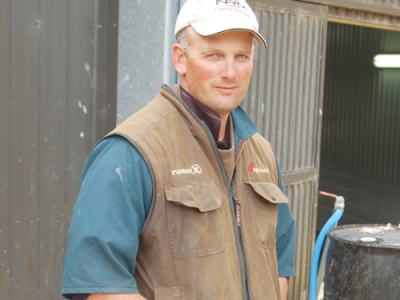 Federated Farmers Waikato president Chris Lewis.
Farmers in Waikato face bills of up to $750,000 to comply with a proposed plan to improve fresh water quality.
A report – the Farm Plan Project -- by Federated Farmers, Fonterra, DairyNZ, the Foundation for Arable Research and Waikato Regional Council says some high country farmers face whopping bills for fencing and water reticulation.
The Healthy Rivers Plan proposed by the council seeks to improve water quality in the Waipa and Waikato rivers by managing the nitrogen, phosphorus, sediment and bacteria entering waterways. Submissions on the proposed plan close at 5pm on March 8, 2017.
Feds wants the plan substantially revised. Waikato president Chris Lewis says the Farm Plan Project was intended as a snapshot of where the Healthy Rivers Plan’s impact would be greatest.
The project did case studies of 13 mainly drystock farms; Fonterra did a similar exercise on 11 of its supplier farms.
“It has been a very useful exercise,” Lewis says. “This report has given us practical experience of how the proposed plan would roll out. Now that we know what the issues are, we will be making strong submissions to council, and calling for substantial revision of parts of the policy.”
Lewis says the farms selected for Feds’ study represented a variety of land uses, farm types, catchments and geographic areas.
Feds’ overall concern was that some farmers, even if they wanted to comply, wouldn’t be able to afford it. In particular there are worries that drystock farms in hill country would find it too costly or difficult to fence all waterways.
Report results suggest the average cost of preparing a farm environment plan would be $4692, and the cost to implement the Healthy Rivers/Wai Ora plan ranged from $0 to $785,687.
For example, a drystock farm on steep country allowed for $479,138 in fencing costs to install an 8-wire post-and-batten fence over 21.8km. While Schedule 1 (development of farm environment plans) provides for other options where fencing land over 25 degrees is not practical, Schedule C (requirements for stock exclusion) does not.
In this example, under the proposed plan the landowner would need to provide water for stock that now drink from waterways, at an estimated cost of $173,000. Other mitigation included three wire fencing, waterway crossings and planting for erosion control, taking the total cost to $306,549.
Depending on the plan’s interpretation the costs to this farm could be $306,549 to $785,687.
Regional council chief executive Vaughan Payne says the project identified discrepancies between the schedules in the proposed plan; these are open to interpretation, leading to widely varying onfarm costs.
“This type of information is exactly why we are testing the implementation of Healthy Rivers/Wai Ora onfarm. This information is invaluable for the submission process and will help with the council’s implementation planning, once the new rules take effect,” says Payne.
Federated Farmers has welcomed new rural policies released by ACT, saying they align closely with its own election priorities.

Federated Farmers is backing Feilding High School’s call to keep Agriculture and Horticultural Science as a standalone subject in Year 11.
Fonterra shareholders can begin voting on Tuesday 20 October in the 2026 Board of Directors’ election, a Co-operative Council election in one Ward, and seven Annual Meeting resolutions.
National’s pledge to introduce 19 new national standards shows the party is serious about getting Wellington out of farming, Federated Farmers says.
Fonterra Co-operative Group chief financial officer Andrew Murray has resigned to take up a role outside the dairy giant.


Federated Farmers has welcomed new rural policies released by ACT, saying they align closely with its own election priorities.

Rural Contractors NZ says proposed changes to land transport rules for agricultural vehicles are a welcome response by the Government to out of date regulations which have seen members hit with huge fines.
Alliance is calling for final applications for its 2027 Graduate Programme, with applications closing on Sunday 25 October.
Decades piloting planes has ensured vet and farmer David Hayes is focused on safety. So, after a serious accident while welding on farm, he is sharing his experience so others can learn from it.
Canterbury milk processor, Synlait Milk has confirmed Leon Fung as its chief executive officer.
OPINION: Making it easier to collect rainwater and use it to grow crops and livestock is a no brainer.





OPINION: The same mainstream media muppets that brought you Jacindamania in 2017 have been flat out pimping for the Opportunities…
OPINION: Your old mate reckons the atrocious way farmers in the UK are treated by their lords and masters in…




