Kuhn Group Sales Dip 9% in 2025 but Orders Signal Recovery
Kuhn Group recorded net sales of NZ$2.27 billion in 2025, finishing around 9% lower than in 2024.




 increase font size
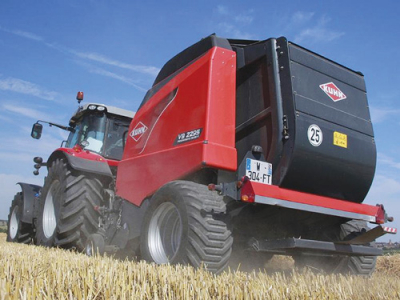
French machinery giant Kuhn bought the Vicon baler business and its factory in Geldrop, Holland, in late 2008 and has continued to develop the product ranges, now offering a choice of up to 16 variable chamber machines.
Two new machines added to the range for the coming season are the VB 2265 and 2296 models. These follow the same layout as existing 2200 series machines, with 230cm pick-ups, bale formation by three rollers and five belts and progressive density control.
However, they also include upgrades to allow 10% greater bale densities. The VB 2265 can produce bales from 0.8 to 1.6m diameter, and the 2295 up to 1.85m.
Aimed at the contractor market and dubbed the ‘heavy duty option’, the progressive density control – which comprises a belt tensioning arm, twin hydraulic cylinders and compression springs – is now subjected to greater operating pressures to control bale density from the core to the exterior.
The increase in pressure from 180 to 235 bar has necessitated an upgrade to the machine drivelines with larger size and increased quality drive chains, lubricated
by the BaleMax continuous oiling system. Driveshafts now also use heavy-duty universal joints to deal with increased torque loadings and a second driven roller on the belt drive system ensures positive bale rotation.
Durability of the machines is further enhanced by Hardox wear plates in the pickup area and on the rotor feeder tine points.
Contractors will also welcome the fitment of oversize 500-45R22.5 tyre equipment, which will help deal with increased bale weights on difficult ground. There’s also ISOBUS connectivity that will make hitch-up a breeze for suitably equipped tractors, as well as including features such as monitors connected to external cameras.
Overall choices include basic non-chopping feeder rotors, a 23 knife cutting rotor delivering a 45mm chop length, and of course the combined wrapper system dubbed VBP.
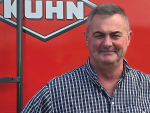
“We have already sold a number of units for the coming season, and although there is a possibility of delivering higher bale weights, we think that current weights are probably enough,” Brian Robertson, operations manager, Kuhn NZ, told Rural News.
“If that’s the case, we think users will probably run the units at around 70% density to deliver similar weights, but with less stress and achieving a longer service life by the machines.”
Kuhn Group recorded net sales of NZ$2.27 billion in 2025, finishing around 9% lower than in 2024.
ZED, the dedicated wholesale division of CB Norwood Distributors, and the importer and distributor for Kuhn in New Zealand, has announced investment in local expertise and stock availability for customers in 2026.
Kuhn has announced an expansion of its range of disc mowers, distributed by Norwood in New Zealand, with the addition of two new vertically folding rear mounted models, the GMD 3515 and GMD 4015.
With most forage harvester manufacturers offering machines touching 1000hp, the logistics puzzle has always been ‘dropping” grass and pulling into a swath big enough to feed the “beast”.
French company KUHN has won a EIMA Technical Innovation Award for its Baler Automation Technology.


Federated Farmers has welcomed new rural policies released by ACT, saying they align closely with its own election priorities.

Rural Contractors NZ says proposed changes to land transport rules for agricultural vehicles are a welcome response by the Government to out of date regulations which have seen members hit with huge fines.
Alliance is calling for final applications for its 2027 Graduate Programme, with applications closing on Sunday 25 October.
Decades piloting planes has ensured vet and farmer David Hayes is focused on safety. So, after a serious accident while welding on farm, he is sharing his experience so others can learn from it.
Canterbury milk processor, Synlait Milk has confirmed Leon Fung as its chief executive officer.
OPINION: Making it easier to collect rainwater and use it to grow crops and livestock is a no brainer.

OPINION: The same mainstream media muppets that brought you Jacindamania in 2017 have been flat out pimping for the Opportunities…
OPINION: Your old mate reckons the atrocious way farmers in the UK are treated by their lords and masters in…




