Claas has announced several improvements for its 2022 JAGUAR 900 forage harvesters, including increased options for the front attachment drive.
In addition to the allmechanical and the variable drives used with ORBIS maize fronts and pick-ups, customers can specify a twin hydraulic drive system that offers benefits when working with grass pick-ups.
“With this option, the pick-up intake auger continues to be driven via a quick release coupler and can adjust its speed in accordance with the feed intake rollers, depending on the length of cut. The new hydraulic drive means the speed of the pick-up reel can now be automatically adjusted to match ground speed of the harvester independently of the speed of the intake auger,” says CLAAS Harvest Centre product manager for JAGUAR, Luke Wheeler.
“This means the rotational speeds of the pickup reel and intake auger can be matched exactly to the prevailing harvesting conditions for more consistent crop flow and higher throughput. This is particularly important when harvesting high yielding crops at low ground speeds or vice versa.”
US studies have shown the new hydraulic drivein connection to the new front can increase throughput by up to 13.7% compared with the existing mechanical constant drive-in heavy harvesting conditions.
In other upgrades, Claas will also introduce an app to help the operator to determine the correct dosage settings based on crop yield, crop type, operating width, working speed and the recommended dosage for its factory-fitted forage inoculant dosing system.
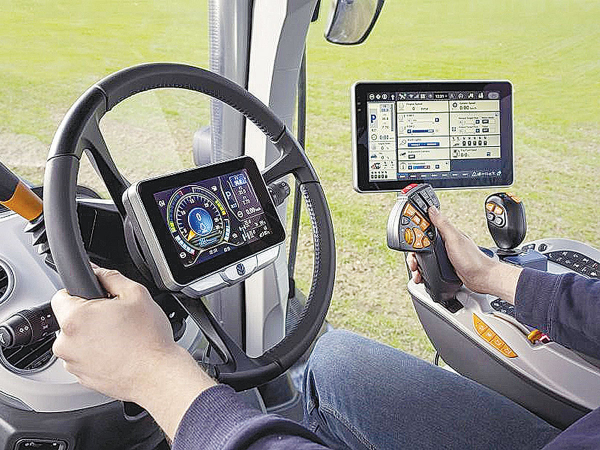
Once the relevant data has been entered, the operator can implement the recommended settings using the CEBIS terminal, with easy adjustment once chopping is underway. The app is said to help avoid underdosage, which can have a significant impact on silage quality; and overdosage, which leads to excess use of expensive inoculants.
Operators can decide whether to use the Actisiler 37-litre tank or the 375-litre water tank and measure dosage in litres per tonne or litres per hectare. With a second, optional dosing pump, silage additive injection can now be doubled, taking it to quantities of up to 800l/hr. The app is available for Android and Apple operating platforms and can be downloaded via connect.claas.com.
The company also announced a new water injection system, for difficult harvesting conditions such as high sugar content grass or high dry matter content lucerne.
The system automatically injects water from the onboard 375-litre tank into the feeder unit, guide plate area, accelerator and discharge chute whenever there is no crop flow – such as at headlands or during forage trailer changeovers.
The system helps stop the build-up of sticky material in the crop flow area, as well as helping to keep the dry matter or NIR sensors clean.