Power Farming Launches Southland Joint Venture
Power Farming has launched a joint venture in Southland.




 increase font size
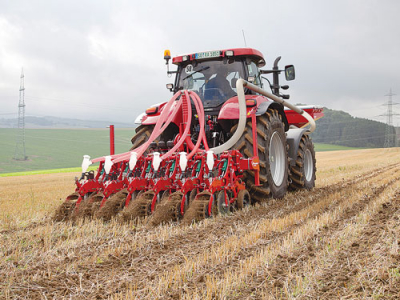 The introduction of the Kverneland KultiStrip System will “bring opportunities to farm environmentally and improve yields and profitability."
The introduction of the Kverneland KultiStrip System by distributor Power Farming will “bring opportunities to farm environmentally and improve yields and profitability,” the company says.
The system uses a one-pass cultivator-fertiliser machine which encompasses a strip-till system to reduce cultivation costs, aid plant establishment, improve soil condition and ensure yields.
Strip tillage is an innovative method of preparing the soil for crops planted in rows, such as maize, beet, sunflower, canola, sorghum, soya, vegetables and hybrid corn. This method has been used for at least 20 years in North America and is now getting traction in Europe and Australia as environmental awareness increases.
Given the pressure to improve the quality of New Zealand waterways, the Kultistrip should offer growers and contractors a tool to help limit erosion, particularly on sloping ground, which will keep regulators away from the farm.
In strip tillage, only the soil where the crop will grow is disturbed, leaving up to 70% of the paddock uncultivated, cutting tillage costs. The uncultivated soil between the strips, and the layer of residue that remains, help to prevent erosion while increasing water absorption and retention in the soil.
Within the cultivated row, trash is removed and a fine seedbed offers the best conditions for young plants to establish. When creating the seedbed, fertiliser can also be placed near the plants for best utilisation. With less of a paddock being cultivated, there is a possibility of completing work during poor weather, or even planting earlier in a season to help bring harvest dates forward.
Looking at the machine in more detail, the rigid 3000, 4500 and 6000 models have working widths of 3, 4.5 and 6m, respectively, and have a heavy-duty mainframe. Alternatively, the 4500F and 6000F models have hydraulically folding frames which bring the units down to 3m wide and 4m high to meet transport regulations.
Both rigid and folding designs of the Kultistrip can be fitted with an even or uneven number of rows, with a row width of 45-80cm. The 3m unit can be configured with up to six rows, the 4.5m up to 10 and the 6m up to 13 rows.
The system layout of the Kultistrip initially has 520mm cutting discs cutting through the crop residues and opening the soil to a pre-set depth, before adjustable trash wheels remove the plant residues from the cultivated strip.
Next, the tines work to a maximum depth of 30cm, with a choice of three options for differing soil types.
An adjustable strip-limitation disc determines the width and shape of the cultivated strip as well as keeping loose soil within the strip. Finally, a press wheel consolidates the soil using a rubber Farm Flex wheel or optional cage roller or V-press wheels for varying soil types.
Fertiliser is placed in the lower levels of the cultivated soil by the fertiliser coulter, as the soil is worked in one single pass. The cultivation tine and the fertiliser tube can be adjusted independently.
Alternatively, the Kultistrip machine can be used with an effluent tanker to place liquid manures in the soil at a pre-determined depth.
Product specialist John Chapman says “the Kultistrip system is multifunctional in that it allows operators to cultivate, deliver mineral or liquid fertilisers and drill in one pass.
Then by utilising a strip-till approach it can reduce establishment costs and help reduce the environmental impact of traditional crop establishment systems”.
Power Farming has launched a joint venture in Southland.
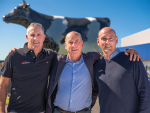
Morrinsville-based agribusiness leader Geoff Maber has been appointed an Officer of the New Zealand Order of Merit (ONZM) in the King’s Birthday Honours, recognising a lifetime of service to agribusiness, the rural sector and the wider community.
Waikato agribusiness leader Geoff Maber has been appointed an Officer of the New Zealand Order of Merit (ONZM) in the 2026 King's Birthday Honours.
With Agritechnica just around the corner, it’s no surprise to see manufacturers drip-feed some information of new products worth a closer look.
Founded in Germany as recently as 1977, today, the Fliegl Group employs more than 1100 workers, offering an expansive range of transport solutions, from their base in Bavaria.


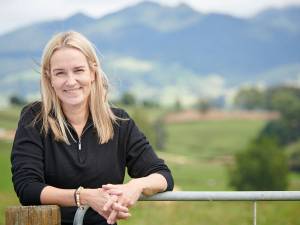
Minister of Conservation Hon Tama Potaka has appointed Susan O'Regan as Chair of the Queen Elizabeth II National Trust (QEII) for a three-year term.
Red meat farmers are welcoming Labour’s plan to review the Emissions Trading Scheme and not to campaign on pricing agricultural emissions.
Where any worker in the kiwifruit industry is mistreated, we expect the authorities to take action.
Mid Canterbury Federated Farmers arable chair, Bevan Lill, said Beef + Lamb NZ data indicated that for the last six years, the average arable return on investment was about 0.8% while inflation ran about 4% - so the average arable farm was going backwards at about 3% a year.
Seed and grain companies share the concerns of arable farmers about the viability of their sector, says Seed and Grain New Zealand chief executive Dr Sarah Clark.
The New Zealand Institute of Forestry (NZIF) says unnecessary changes to New Zealand’s Emissions Trading Scheme (NZ ETS) will seriously erode investor confidence and result in significant reductions in forest planting rates.


OPINION: The same mainstream media muppets that brought you Jacindamania in 2017 have been flat out pimping for the Opportunities…
OPINION: Your old mate reckons the atrocious way farmers in the UK are treated by their lords and masters in…




