New seed drill tech coming
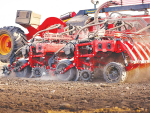
Incorporating Vaderstad's latest seed drill technology, the Proceed V 24, is said to improve precision and increase planting efficiencies for New Zealand farmers and growers from the 2026 season.




 increase font size
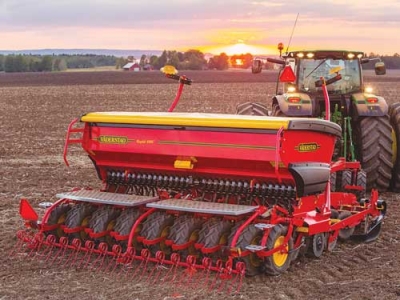
Vaderstad has a long association with drills, the first production Rapid models drilling peas in Suffolk, UK, for supply to Birdseye in 1992.
Over the years the Rapid gained a reputation for a simple design that made it robust and dependable, accurate in placement and depth control, low in power requirement and able to deal with trash during direct drilling.
The layout has rubber mounted discs to the front of the machine that chop and loosen the stubble, which can also be preceded by cross boards for levelling.
The drilling element has a packer wheel that controls the drilling depth of a pair of coulters via a mechanical linkage, and the rubber mounting results in a fluid movement at high speed; pressure can be up to 150kg per unit for good penetration in hard conditions.
Spacing is set at 125mm and uses a single disc for a narrow seed furrow; the serrated edge delivers fine soil for seed covering and rapid emergence. Fertiliser placement is set at 250mm, so is between every second seed row, with a target depth of 20-30mm below the seed.
After drilling, consolidation is done by a wheel that covers two seed and one fertiliser row, and a 190mm set-back between banks to allow soil and trash to pass through without the soil build-up associated with single row press systems, and resulting in a lower draught requirement. Following up the rear is a harrow set up between the rows to prevent seed disturbance, while leaving a friable surface to resist ‘capping’ from any rain.
Upgrades for the 2015 season include a new streamlined hopper mounted slightly higher above the drilling element, allowing much better access, and ‘grease-less’ disc hubs assembled during production – fewer grease nipples needing daily attention.
A re-design of following harrow geometry achieves better lift height in turns; it also allows a choice of mechanical or hydraulic adjustment -- the latter on-the-go, which might be a requirement for the ‘lands’ or the headland.
Notably, the addition of a hydraulic seed metering drive allows full optimisation of the new control technologies such as Control Station, ISOBUS and E-Control. The former is used to adjust seed rate, lay tramlines, set bout markers and control half-machine shut-off; ISOBUS removes the need for individual control boxes for many machines.
The E-Control system uses the latest wireless technology via an iPad Air tablet to adjust seed rates, seed spacing, fertiliser rates and on/off function. After drilling is completed field data can be uploaded to the farm office or the cloud, and the tablet can be used for accessing operators’ manuals or parts listings.
VADERSTAD HAS a long association with drills, the first production Rapid models drilling peas in Suffolk, UK, for supply to Birdseye in 1992.
Over the years the Rapid gained a reputation for a simple design that made it robust and dependable, accurate in placement and depth control, low in power requirement and able to deal with trash during direct drilling.
The layout has rubber mounted discs to the front of the machine that chop and loosen the stubble, which can also be preceded by cross boards for levelling.
The drilling element has a packer wheel that controls the drilling depth of a pair of coulters via a mechanical linkage, and the rubber mounting results in a fluid movement at high speed; pressure can be up to 150kg per unit for good penetration in hard conditions.
Spacing is set at 125mm and uses a single disc for a narrow seed furrow; the serrated edge delivers fine soil for seed covering and rapid emergence. Fertiliser placement is set at 250mm, so is between every second seed row, with a target depth of 20-30mm below the seed
After drilling, consolidation is done by a wheel that covers two seed and one fertiliser row, and a 190mm set-back between banks to allow soil and trash to pass through without the soil build-up associated with single row press systems, and resulting in a lower draught requirement. Following up the rear is a harrow set up between the rows to prevent seed disturbance, while leaving a friable surface to resist ‘capping’ from any rain.
Upgrades for the 2015 season include a new streamlined hopper mounted slightly higher above the drilling element, allowing much better access, and ‘grease-less’ disc hubs assembled during production – fewer grease nipples needing daily attention.
A re-design of following harrow geometry achieves better lift height in turns; it also allows a choice of mechanical or hydraulic adjustment -- the latter on-the-go, which might be a requirement for the ‘lands’ or the headland.
Notably, the addition of a hydraulic seed metering drive allows full optimisation of the new control technologies such as Control Station, ISOBUS and E-Control. The former is used to adjust seed rate, lay tramlines, set bout markers and control half-machine shut-off; ISOBUS removes the need for individual control boxes for many machines.
The E-Control system uses the latest wireless technology via an iPad Air tablet to adjust seed rates, seed spacing, fertiliser rates and on/off function. After drilling is completed field data can be uploaded to the farm office or the cloud, and the tablet can be used for accessing operators’ manuals or parts listings
Stats
Incorporating Vaderstad's latest seed drill technology, the Proceed V 24, is said to improve precision and increase planting efficiencies for New Zealand farmers and growers from the 2026 season.
Väderstad’s Rapid A 400-800S, Rapid A 600-800C, Spirit 400C/S and Spirit 600-900C/S pneumatic seed drills have received a new distributor head that can be fitted with motors for all outlets.
Vaderstad's high speed precision planter Tempo is to get two key updates for 2024, with the addition of new electronics to optimise accuracy, alongside the introduction of a liquid fertiliser system.
While many industry watchers have been singing the praises of the latest and greatest innovations at the recent Agritechnica Event, held recently in Germany, agricultural journalists have been deliberating the winners of the Farm Machine of the Year 2024.
Tillage, drilling and planting specialist Vaderstad has expanded its offering with the addition of the new 7.25-metre-wide, XL 725 to the Carrier XL range of disc cultivators – spanning working widths from 4.25 to 12.25 metres.


Healthy snacking company Rockit has announced Wang Yibo, one of China's most influential celebrities, as its new brand ambassador.
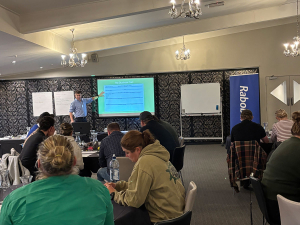
Rabobank has celebrated the tenth anniversary of its AgPathways Programme, with 23 farmers from Otago and Southland gathering for two-and-a-half days to learn new business management and planning skills.
Adopting strategies to reduce worm burden on farm goes hand-in--hand with best practice farm management practices to optimise stock production and performance, veterinarian Andrew Roe says.
Last night saw the winners of the 2026 Beef + Lamb New Zealand (B+LNZ) Awards named at a gala dinner at Te Pae Christchurch Convention Centre.
A 12-month pathway programme has helped kickstart a career in dairy for an 18-year-old student-turned-farmer.
Zespri says its global fruit sales revenue has reached a record NZ$5.9 billion from sales of 248.1 million trays.


OPINION: The old saying 'a new broom sweeps clean' doesn't always hold up, if you ask the Hound.
OPINION: This old mutt went to school to eat his lunch, but still knows the future of the country, and…