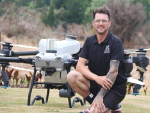
Wairarapa’s Bradley Wadsworth blends farming and technology
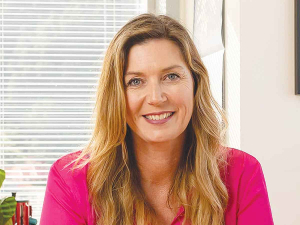
Bradley Wadsworth lives on the family farm – Omega Station – in the Wairarapa about 30 minutes’ drive east from Masterton.




 increase font size
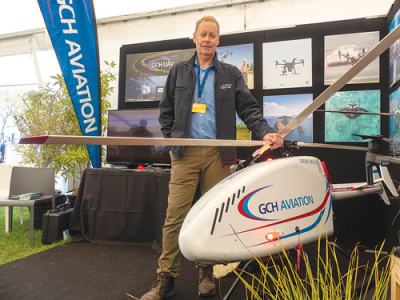 GCH Aviation’s Drone Operations manager Rob Duff with the large gas turbine drone the company is trialling for a range of applications including agriculture. Photo: Rural News Group
The world may be going all-out on electric vehicles, but GCH Aviation, Christchurch, is trialling a large, gas turbine-powered drone to service farming clients.
GCH (formerly Garden City Helicopters) was showing off a Swiss-made SD50 at last year’s New Zealand Agricultural Show, carrying a $500,000 price tag.
It has two contra-rotating intermeshing rotors so no tail rotor is required. It can fly for 2.5 hours and carry a payload of 40kg. That endurance is a game-changer, claims Darryl Hodgson, general manager of GCH’s UAV (unmanned aerial vehicle) division.
“At the moment, it doesn’t matter what [drone] you’ve got, they’ve all only got a battery life of about 20-30 minutes.”
And the battery life will be even less in a drone that must power, say, a big multi-spectral camera or high-end LIDAR unit. However, uniquely, the SD50 carries its own generator.
GCH Aviation has bases NZ-wide and experience in helicopter and fixed wing services.
It entered the UAV sector in Marlborough about two years ago and now flys electric drones to map farms and vineyards to monitor for pests, diseases and growing stresses such as moisture and nitrogen deficiencies.
At first it met resistance from farmers who had been burned by “backyard guys” who flew off-the-shelf drones and sold the farmers nothing more than “pretty pictures”. Now it can provide collected data and proper analysis of that data.
GCH contracts this part of the service to an experienced US partner company which delivers a report to the farmer in the preferred format. An example is delivering instructions for a GPS-enabled, variable-rate fertiliser or spray application.
The SD 50 can also be configured with a spray boom for use on high-value crops or weed control in areas of poor access, typically where a full-size manned helicopter would not be economically viable.
Hodgson says that while the concept is not new, having a seamless package was preferable to dealing with several providers.
He says the SD50 gas-turbine power unit opens the door to survey a farm of 200ha in one go and at very high accuracy.
Bradley Wadsworth lives on the family farm – Omega Station – in the Wairarapa about 30 minutes’ drive east from Masterton.
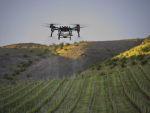
Felton Road Wines is using an electric drone sprayer to apply organic fungicides and monitor crops, cutting emissions and transforming management.
Use of agricultural drones by contractors in New Zealand is soaring.
While we are seeing more and more drones being used in New Zealand agriculture, we’re some way behind the US, where in places like the Midwest, the drones are certainly bigger than Texas.
As drones get bigger, broadacre applications like arable spraying will become more common, says the Canterburybased founder of Drone Spray, Jono Scott.


Waikato milk processor Tatua has again declared a record milk payout to farmer shareholders, leaving other processors in the dust.
A Labour-led Government won’t be bringing back the controversial freshwater rules of 2020.
National’s much-touted free trade deal with India featured in the Rural Issues Debate at Mystery Creek, Hamilton on Wednesday night.
New Zealand's 2026-27 freshwater fishing season has opened, with anglers encouraged to head to rivers and lakes over the coming days as conditions look favourable across much of the country.
Central Otago District Council (CODC) has voted against a plan to spread treated sewage sludge from Cromwell and Alexandra on farmland near Lauder, a decision Federated Farmers says reflects strong opposition from rural residents.
Pāmu has released its FY26 Integrated Annual Report, reporting a Net Operating Profit of $113 million, more than double the $49 million recorded in FY25.





OPINION: The same mainstream media muppets that brought you Jacindamania in 2017 have been flat out pimping for the Opportunities…
OPINION: Your old mate reckons the atrocious way farmers in the UK are treated by their lords and masters in…




