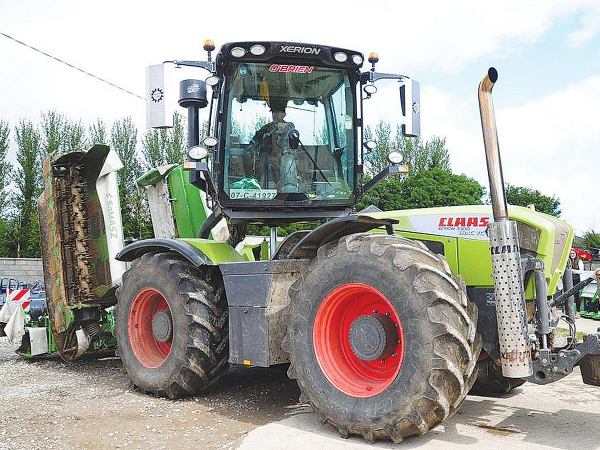
German manufacturers have always had a belief that tractors should be multi-purpose vehicles.
The only real divergence was those set up for field work and those for haulage. The latter saw the adoption of four wheeled trailers with turntables, said to be better suited to the task – a thought still held today.
The Claas Huckepack, built between 1957 and 1960, was a tool carrier produced to work large areas of root crops. This was at a time when Claas was also leading the field in combine harvesters.
During the late 1960s the company was working on a new hydrostatic transmission called HSG, which was installed in a dual-purpose tractor/ truck test rig. Over time, a distribution agreement with Daimler-Benz was proposed for the new tractor, which in due course, led it to create a model of its own that became the MB Trac.
The HSG tractor project was shelved in 1972— but not forgotten. In 1978, HSG was renamed Project 207, and heralded the birth of Xerion. Despite internal company enthusiasm, it took until 1993 for the concept to be made public by Claas and it became available for purchase in 1997 with the Xerion 3000.
At its heart, lay the HM-8 infinitely variable transmission. This drives the permanently engaged equal sized wheels, showcasing the development work started in 1968 and featuring the novel option of a revolving cab. Until then, reverse drive tractors spun the seat to face a rear-mounted duplicate set of controls.
Developed with a 200hp engine from MAN, the first production models saw a power jump to 250 and 300hp for the Xerion 2500 and 3000 respectively – using a six-cylinder Perkins 1306-9TA in both variants.
When AGCO bought the Challenger rubbertracked business from Caterpillar in 2001, Claas was left with Xerion as its only prime mover. This eventually led to the purchase of Renault’s tractor division in 2003.
The Xerion saw a major facelift in 2004, which saw a ZF transmission replace the company’s own unit, alongside the use of Caterpillar engines signalling the 335hp Xerion 3300 and 364hp Xerion 3800. Around the same time, the Saddle Trac option saw the cabin sit above the engine, clearing the rear ‘deck’ of the tractor. This allowed the fitting of fully-mounted slurry tanks with sprayers or the installation of a fifthwheel coupling to tow larger trailers.
This second generation Xerion endured until 2013, but was also joined by Gen 3 in 2009, with the arrival of Xerion 4000 and 5000 with 449hp and 487hp outputs. This was achieved by swapping the Cat C9 engine with a Cat C13, still a six cylinder, but with 12.5L displacement rather than the smaller 8.8L.
In 2014, Xerion 4000 and 5000 were given a Mercedes Benz OM 471 LA engine. This brought power increases that saw the 5000 delivering 509hp, the 4500 at 480hp and the 4200, arriving with 458hp.
Today, the range offers three power levels, each with three cab options and the availability of triangular crawler tracks (Trac TS) on the two larger models.