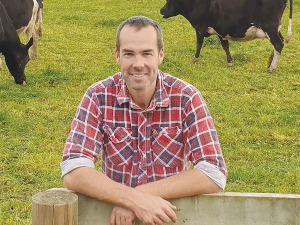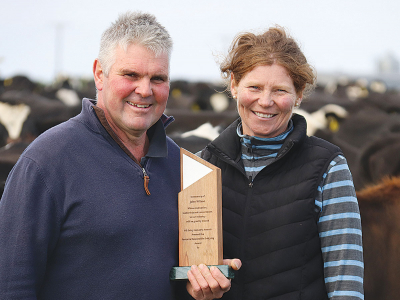
Damian and Jane Roper, who with their children Jack, Harriet and Adelaide run a 148ha dairy farm near Patea, Taranaki, recently won the Fonterra Responsible Dairying Award and received the John Wilson Memorial Trophy.
The award recognises dairy farmers who demonstrate leadership in sustainability and who are respected for this by fellow farmers and their community.
An award judge summed up the Ropers as “passionate, enthusiastic and energetic with an ability to motivate those around them. They are determined to be better than just compliant”.
The Ropers knew John Wilson personally and receiving a trophy with his name on it is special to them.
Their success as sustainable dairy farmers has come by hard graft and an unwavering vision of creating a modern, tidy dairy farm that is profitable and has no negative impacts on the environment.
Jane was born on a sheep, beef and cropping farm in South Australia, north of Adelaide. Damien was born in Rotorua and often holidayed on his grandparents’ dairy farm at Rununga on the West Coast. He helped milk their 30 cows.
“That set me up for being a farmer. I knew when I was 11 that I wanted to be a farmer and went to Massey University and did a B.Ag.Sc.”
With his studies finished they shifted to Australia where he learned and practised shearing in Wales and England.
Returning to NZ in 1992, Damien continued shearing until an injury to his wrist forced him to take a break.
“During that time we came to Taranaki for my best man’s wedding. We got a nice feel for the place and saw a pathway to farm ownership which was always our goal,” he told Rural News.
For 23 years they climbed the dairy industry ladder – from farm workers to contract milkers and then 50/50 share milkers. In 2006, the Ropers bought part of their present farm and the second block in 2008. In 2015 they quit sharemilking and set up home on the present property.
The farm is 200ha: 148ha dairy, 30ha pine trees, 4ha bush and the rest in a small sheep and beef operation. The Ropers run 150 ewes and produce lambs for the summer market and then trade 25 to 30 steers and heifers they rear each year and take through just one winter.
Living their dreams
Damien and Jane Roper live their vision in managing their farm.
For example, their large modern dairy shed with feed pad is designed to maximise feed utilisation and reduce their animals’ environmental footprint. They have reduced stock numbers but lifted production by 29% over three years.
“We used to run 510 cows, but now we run 425, resulting in less pressure on the whole farming operation,” Damien told Rural News.
“We have noticed cow production has lifted considerably with less stress during winter and spring and we can cope well when extremes happen due to climate change.
“We are better off with 425 high quality cows that are more efficient at converting grass into milk, than 510 average/below average converters that emit more greenhouse gases.”
“With 510 cows their stocking rate was 3.2 but it’s now 2.7.”
“They have built a quality herd of two thirds Friesian and one third Friesian cross. This season they will end up producing 240,200kgMS (586kgMS/cow).
“When we had 500 cows we were barely doing 400kgMS/cow, so you can see how having fewer better cows has helped raise production,” Damien says.
“Also reproduction and in-calf rates have improved, allowing replacement numbers to be reduced.”
But it’s not all about reducing cow numbers.
The Ropers operate on system four and to maximise inputs they have hired a nutritionist to ensure they feed “the right amount of the right feed at the right time”.
And they re-grass about 18% of the farm annually, mostly using no tillage. Everything is designed to lower their environmental footprint.
Setting an example
In the seven years before they started running the present farm in their own right, Damien and Jane Roper started planting trees.
They reckon they have planted at least 9000 – many around a 2ha lake they created in a boggy gully. They call it Lake Ohurai after the stream that feeds it.
They have even created artificial islands to foster the bird life, Jane says. “When we took over the farm it was probably the ugliest area. Now it’s the most picturesque. We have made underwater reefs for the kura and planted a whole range of native tree species to improve the aesthetics of the lake and provide food for the birds.”
The family also regularly swim and kayak in the lake and continue planting there.
“We have noticed a lot of duck species coming in -- teal, scaup, dab chicks and flocks of herons,” Damien says. “We have planted carex near the water’s edge which provides good areas for nests.”
And that’s not all.
Just outside their back door is a beautifully preserved stand of native bush they call Ropers’ Bush. Its upkeep and preservation is the work of their children Jack (23), Harriet (21) and Adelaide (16).
The trees took a hammering in the 2012 storms. But with the help of the Taranaki Regional Council, the Ropers have restored the bush and their children are now building a boardwalk for public viewing without damage.