He leaned on his trusted team, including veterinarian Simon Marshall, to form a parasite management plan and tackle the problem head-on.
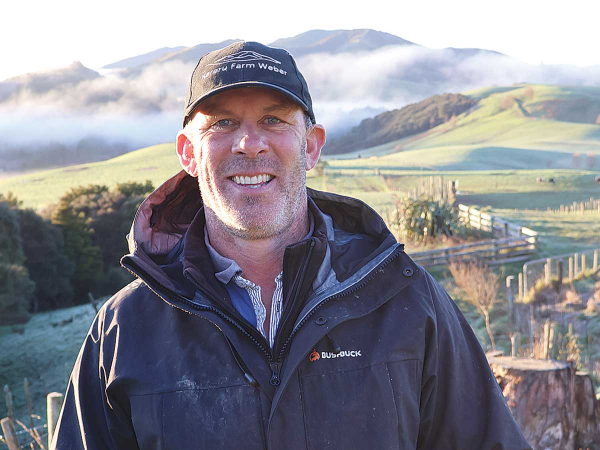
Kereru Farm is a 940ha (575ha effective) sheep and beef farm in Weber, Tararua district. Hales runs a 50:50 ratio of sheep to cattle at 11 stock units/ha. Today, the sheep enterprise involves 1600 breeding ewes, with no hogget mating, and finishing lambs. They run 140 breeding cows and sell yearling calves. There is a large beef trading component of bulls and steers.
Despite no indication there was a worm problem on the sheep and beef farm, a routine drench check in 2018 revealed the scale of the issue.
Production animal veterinarian with Vet Services Dannevirke, Simon Marshall, describes the result as “scary”, so much so he didn’t believe it at first. A second check proved that drench resistance was indeed present. A full drench reduction test the following season confirmed their fears.
At that time, triple drench resistance was known of but hardly spoken about – it was certainly not something you wanted to tell anyone you had. Hales has always been open to change, and he was willing to do whatever it took to reverse the resistance, even though he wasn’t sure if that was possible.
“It was probably the first time I had seen it (triple drench resistance) in reality. There wasn’t a lot around, or it certainly wasn’t commonplace,” Marshall says.
They started by going over their system with a fine-tooth comb, eliminating other possible causes, like storage of product or incorrect dosage.
Hales was lucky to have a good team around him, particularly Marshall and farm consultant John Cannon. Marshall brought the expertise in animal health and genetics and Cannon was able to run a lens over any possible farm system changes recommended, to ensure they could still run a profitable business, while tackling drench resistance.
“The business still needed to make money and that’s where John could cast a lens over it. A vet can give you best practice, but sometimes that won’t work in terms of returns, so there has to be a middle ground,” Marshall explains.
They understood it was not a problem that could be fixed overnight, and it would be a long journey. They came up with scenarios of what could work from a farm system point of view, while implementing best practice to reduce the worm burden.
Back then, Hales was running an 80:20 sheep to cattle ratio. He stopped drenching ewes, knowing he needed to drop numbers and change the ratio. Stopping drenching allowed him to identify and cull ewes he didn’t want.
They analysed the land classes and identified areas that were not returning value from sheep. This allowed them to diversify and make changes to the stock policy, with integrated grazing a core tactic to ease the worm pressure.
He also started selling store lambs, only retaining what he could fatten on the property. “It was about making sure the numbers were right and increasing different stock classes of cattle. Every part of the farm now has different classes of stock go through it.”
Feeding stock well was another key factor, reducing ewe numbers and lifting covers to feed every animal to its potential, all year round.
Finally, regular monitoring was crucial. The animal health plan set out regular intervals for drench tests and faecal egg counts (FEC), with decisions made based on information.
“Now we are farming far better than we were then. Part of it is regular monitoring through drench checks and FEC but also genetic selection has played a massive role. I select strongly on traits like dag score and worm FEC.”
A Collaborative Approach
Today, Kereru Farm is proof that drench resistance is not a death sentence.
A collaborative approach to farm systems changes led to overall improved farming practices and better productivity outcomes, with minimal reliance on the use of drench. And now, their drench status is good.
Discovering drench resistance was a trigger to speed up farm system change that would have happened regardless, Simon Hales says. All the changes made, with drench resistance in mind, have added up to increase production from his sheep flock exponentially, lifting killing weights and increasing production per hectare.
It’s been a team effort and Hales is a big campaigner for working alongside your vet.
“My vet is a key player in the game of farming. When it came to the drench resistance issue, having that relationship with production animal veterinarian with Vet Services Dannevirke, Simon Marshall, he understood my farm system and everything we put in the animal health plan, he was able to relate back to the issue we had. Everything we do now is still trying to mitigate the situation we had in 2018.”
For Marshall, it’s about being open to a conversation with your vet about the big picture, not simply asking for advice on what drench to use. Things like the farm system, genetics, good feeding and regular monitoring can all contribute to lower drench use, and should be taken into account.
“We need to be thinking about working with that farmer for the next 50 years, not just the next five years.”
- Article supplied by Zoetis