It's The Margins That Matter
OPINION: It appears to be difficult for people who haven’t tried to run a business to understand the difference between assets and cash.




 increase font size
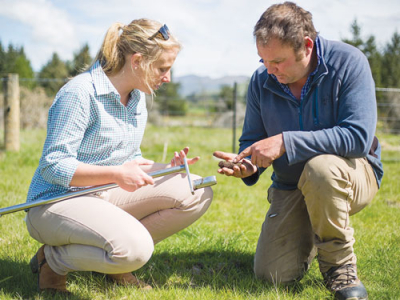 Andrew Hurst and Ravensdown agri manager Hannah Wallace checking the soil.
Mackenzie Country high country farmer Andrew Hurst has not stood still since he took over the lease of two adjoining farms four years ago.
Run as one unit, the farms belong to his parents, covering 2300ha from pasture to tussock and into high alpine and mountain terrain.
Hurst is committed to developing the land and building stock numbers, to put him in a position where he and wife Jo can try to buy the business outright.
“You get out of your land what you put into it; you can’t cut corners,” he says.
Hurst’s sheep and beef operation runs 3300 Coopworth ewes, 900 hoggets and 300 angus beef cows; it finishes all the heifer calves and most of the lambs. He is also reclaiming about 10ha a year and continually re-fencing.
The harsh climate of the Mackenzie Country has him spending all summer preparing winter feed to get the animals through.
“Low soil fertility is a big problem in the Mackenzie Country: it has acidic soil so a lot of lime is required. We get good summer rainfall which is in our favour, however we’ve a lot of weeds.
But if you’ve done everything right, when the rain comes the crop will grow. To get the best silage stocks and crop growth we’re continually soil testing, to build up fertility.”
While his father always had a good handle on soil testing, Hurst has moved to develop the farm using SmartMaps and aerial technology bought from Ravensdown.
“We’ve come a long way in the last three years. This is only our fourth season on our own and we’re starting to get somewhere now. We’re running 400 more ewes and finishing more cattle with new pastures. The ewes are the best they’ve ever been this season due to high performing crops.”
Hurst has spent a lot on continually monitoring and assessing the business, which he says has paid dividends.
“I try to do everything properly. We don’t cut corners on cropping, fert, agri chemicals or seed. If I get a recommendation from Ravensdown I do it. We can’t afford to have a failed crop as we rely heavily on winter feed and we haven’t had one yet. Whatever it needs – direct drilling, spraying early, two sprays, urea – if it needs capital, it happens. It can be tempting to try to reduce costs by cutting corners on drops, but it doesn’t work and you end up paying for it.”
Hurst says a good example was last year, challenging for everyone because of dry windy conditions.
“But we had good crops and lambing and it ended up being a great season for us. The key is you get what you pay for. Ravensdown’s attention to detail and knowledge has headed off a few things by being onto it early. Twice last year bugs were moving in but Ravensdown’s seeds technical manager for the South Island, Lisa Chapman, made an early call and we pretty much saved the kale crop from nysius fly, which can decimate a paddock if you leave it.
“A month later Lisa and her colleague Andre Callaghan advised on putting on the urea at the right time and we ended up getting a prize in the winter feed competition for that same kale crop.”
Hurst says with just him on the farm, and a small amount of casual labour, it can be busy place.
“I can’t be everywhere all the time so I have to rely on good advice and product. You can’t afford to let your guard down when it comes to winter feed. It’s well worth doing it properly for tonnage.”
OPINION: It appears to be difficult for people who haven’t tried to run a business to understand the difference between assets and cash.
OPINION: In the 1980s, concern was expressed in West Germany about the falling birth rate. Some simple analysis was performed by Professor Helmut Sies, physician and biochemist at Dusseldorf University. His letter ‘A new parameter for sex education’ was published in Nature in 1988:
When it comes to annual rebates, it's been a long time between drinks for Ravensdown shareholders.
Ravensdown has reported a net profit before tax and rebate of $50.1 million for the year ended 31 May 2026.
Farmer owned co-operative Ravensdown has signed a two-year naming rights sponsorship of the Canterbury A&P Show.
Farms across the upper North Island are trialling different pasture mixes as part of a research programme that aims to build greater resilience into farming systems.
Election years are always a concerning time for farmers, according to DairyNZ chair Tracy Brown.
The Ballance Farm Environment Awards are coming to the West Coast of the South Island.
Most dairy regions around the country have had a pretty good season so far says Tracy Brown.
Rural leader Mark Hooper has been appointed as an independent director to the NZPork board, bringing extensive farming, governance and advocacy experience to the role.

OPINION: The same mainstream media muppets that brought you Jacindamania in 2017 have been flat out pimping for the Opportunities…
OPINION: Your old mate reckons the atrocious way farmers in the UK are treated by their lords and masters in…