
Federated Farmers Backs Year 11 Agricultural Science
Federated Farmers is backing Feilding High School’s call to keep Agriculture and Horticultural Science as a standalone subject in Year 11.




 increase font size
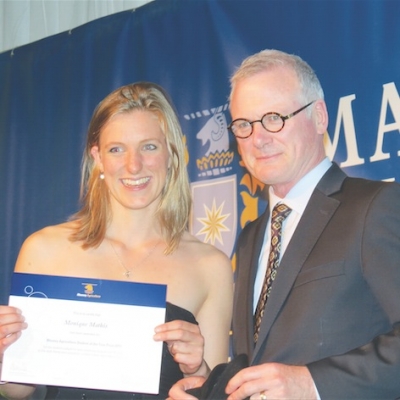 This year’s Massey University top Ag student, Monique Mathis
TO ACHIEVE our goal of doubling exports by 2025 we need to ensure industry has the right people with the right skills. Already there are 350,000 people in New Zealand employed in the primary sector. By 2025 there will be closer to 400,000.
Earlier this year DairyNZ, MPI and Beef + Lamb New Zealand jointly commissioned a report to forecast the capability needed to keep our primary industry internationally competitive. This valuable piece of work will point us towards the present and future skill gaps. The task ahead will require creative thinking, not just business as usual.
Data from Ministry of Education shows that of the 25,000 domestic bachelor graduates in 2013only 350 graduated in a primary sector-related discipline. I saw a recent comparison of 100 agricultural science degrees and 120 in acupuncture. We have a lot of work to stimulate interest and uptake in these fields.
Agricultural science, farm management and agribusiness are all key fields for the primary sector. Fortunately we have seen gradual increases in student numbers in these fields at all qualification levels (certificate, diploma and degrees) over the past two years.
Currently only about 10% of students study agriculture at year 12, and only 2.6% go on to study it in their final year at school. Unfortunately, 30% of those students also fail University Entrance and only 28% go on to study an agricultural related discipline at university.
Too few high-achieving school leavers take agriculture-related studies at bachelor degree level. In contrast, there are at least 6000 commerce graduates each year and we need at least some of them in the primary sector.
Our future capability forecast showed that those qualified in management, commerce, engineering or construction would also be in hot demand in the dairy industry.
By 2025, businesses are likely to be larger, more productive and using more technology. We are going to need strong business expertise in the sector.
As a rural-economy nation, our primary sector should be the natural place for bright young business grads to begin. We need to do more to encourage and promote the sector as an attractive and fulfilling career option to our talented young people. Let’s take time to assess the entire pathway through education to see if it is fit for the purpose of achieving our goal of 50,000 or more.
The promotion of the primary sector industry starts at our schools. I attended a function at Parliament last week where I spoke with a group of careers advisors and teachers. There was a consensus among many of them that the message needs to get to the parents and grandparents as much as to the students.
If we want to attract talented young people into the primary sector we need to make them, and their parents, aware of the opportunities (and salaries!) available to them in the sector.
The Ministry has teamed up with Dairy NZ to launch the Enterprising Primary Industry Career challenge, to encourage high school students to identify careers within the primary sector. These industry-government initiatives are invaluable in our goal to help the sector attract and retain talent.
• Jo Goodhew is the Associate Minister for Primary Industries.
Federated Farmers is backing Feilding High School’s call to keep Agriculture and Horticultural Science as a standalone subject in Year 11.

Pāmu has welcomed Taranaki student Paige Burston as its newest First Foundation Scholar, supporting her journey towards a career in agriculture and animal science.
Kaikōura families affected by July's severe storm have found a practical solution to a problem that's kept some children away from regular schooling for weeks: a washed-out section of Inland Kaikōura Road, which has stopped the local school bus from running its usual route.
Special courses for secondary school teachers to help excite kids about agriculture and horticulture are now being run at Massey University.
OPINION: Proponents of regenerative agriculture tend to be naturally aligned with a 'green mindset', so they will be nonplussed with their new mates in the US of A.


As part of its Election 2026 coverage, Rural News asked political parties how they would help pull the arable sector out of the doldrums. Here's what they said:
Farmers are being encouraged to rethink how they manage waste on farm with the launch of ruralwastesorted.co.nz, a new website bringing together practical tips, real farmer experiences and resources.
New Zealand Winegrowers (NZW) is celebrating the India-New Zealand Free Trade Agreement (FTA) coming into force today, bringing New Zealand wine improved access to one of the world’s fastest-growing economies.
New Zealand’s red meat sector has welcomed the India-New Zealand Free Trade Agreement taking effect, which removes India’s 33% tariff on New Zealand sheepmeat.
More than 95 per cent of New Zealand’s forestry and wood exports to India can now enter tariff free as the New Zealand-India Free Trade Agreement comes into force today.
Federated Farmers is backing Feilding High School’s call to keep Agriculture and Horticultural Science as a standalone subject in Year 11.



OPINION: The same mainstream media muppets that brought you Jacindamania in 2017 have been flat out pimping for the Opportunities…
OPINION: Your old mate reckons the atrocious way farmers in the UK are treated by their lords and masters in…




