Tiki Is NZ's First Regeneratively Certified Vineyard
Tiki Wine & Vineyards has become the first vineyard and winery business in New Zealand to achieve regenerative certification status by A Greener World.




 increase font size
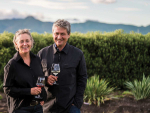
 Royce and Sue McKean
If soil could smile, the earth beneath Tiki Wine & Vineyards would be thoroughly beaming right now.
Tiki was recently named the first Certified Regenerative vineyard and winery in Aotearoa by A Greener World – the largest, independent, regenerative certifier on the planet. Tiki’s founders, Royce and Sue McKean, were chuffed at the news. “It was awesome to have all the work that the team has been doing over the last six years registered to a world standard,” says Sue. “We’re pretty excited about it,” adds Royce. “But it was also a bit surreal. We didn’t actually realise we were going to be the first until A Greener World indicated that there wasn’t anyone else certified in New Zealand.”
Not bad for a plot of land that used to host grazing sheep and lambs. Not bad for two self-described “ski bums” who took a chance on grapes after returning from their OE. “From the minute Royce and I got together it’s been about trying to do our own thing, have our own grubstake,” Sue says.
In order to build that grubstake, they left their cruisy ski field jobs in the Craigieburn Range and headed overseas, two young daughters in tow, to earn some decent money. They found lucrative work in the then-booming banking scene and returned to New Zealand several years later with enough capital to seed the dream to buy an old 364-hectare sheep farm in Waipara, North Canterbury.
That farm became Waiata Vineyard, where they planted 60ha of Sauvignon Blanc and Pinot Gris varieties in 2005 and added more the following year. Back then they were “green behind the ears, with limited funds and no track record to speak of in grapes or wine”, Royce says. “Actually, that’s probably being generous.”
But they must have been doing something right, because their very first vintage, Tiki Single Vineyard Sauvignon Blanc, won a gold medal in 2009. Royce lays this honour at the feet of what he calls the Tiki whānau. “We’ve had some amazing viticulturists and winemakers over the years, and a really great team.” The learning curve was steep though. “One of the key tenets of regen is low or no till. We completely cocked that up – we ploughed and when the wind came through, our topsoil blew away. So we were pretty much 100% non-regen in terms of our approach.”
After a bit of trial and error, they fell into sync with the land. Royce’s mum, Sally Hariata McKean (Ngāti Uenuku Kōpako, Ngāti Ranginui, Ngāi Te Rangi), was hugely influential in this regard. As a woman who loved the feel of soil under her hands and understood the importance of kaitiakitanga – guardianship, protection and preservation of the earth – Sally was happy to impart her wisdom. Indeed, she became Tiki’s north star. “Mum’s been central to our Tiki values – both internally (the way we treat each other) and externally (how we go about things and extend manaakitanga),” Royce says. “She instilled a lot of those lessons and was a very strong and helpful guiding hand in terms of how we’ve gone about things.”
Sally, who passed away in 2022, was integral to their branding too – the name Tiki is a nod to her great-greatgrandfather, a Ngāti Uenuku Kōpako chieftain called Tikitere Mihi. “When we think of our branding and the wines we make, we’ve got Mum in the back of mind. We try and approach everything as though we’re doing it for her, representing her,” Royce says.
The McKeans deepened their loyalty to the principles of kaitiakitanga by becoming founding members of the TUKU Māori Winemakers Collective – a group of producers with a shared commitment to indigenous stewardship and cultural authenticity. It’s this drive for authenticity and transparency around wine production that also prompted them to align with A Greener World. “There are very few avenues for certification for vineyards farmed under the regenerative system – particularly in the Southern Hemisphere,” Sue says. “So, it’s harder to communicate the degree of care and attention lavished on the grapes to the end consumer.”
The road to regenerative certification was no quick dash; it’s been years in the making. Already an accredited member of Sustainable Winegrowing New Zealand, the Tiki crew began rolling out regenerative measures on Waiata Vineyard in 2020, by building healthy soils, increasing biodiversity and creating a thriving ecosystem above and below ground – or, as Royce puts it, “providing an environment for nature to flourish and then getting out of the way”.
They then had to develop a five-year plan describing their intentions around soil, water-holding capacity, nutrients, biodiversity and social responsibility. This meant lots of back-and-forth-ing and on-site visits. “You’re essentially proving your traceability all the way through to the bottle,” says Sue.
Lastly, they had to commit to ongoing annual audits that will measure continuous improvements. This will play havoc with their snow time, for sure. “The idea was that we were meant to be getting semi-retired and doing some more skiing, but it’s not going to work out like that.” Royce says. “We’ve probably just lined ourselves up for more work.”
Their deep dive into matters regenerative has turned them into a pair of soil obsessives. “Globally, the knowledge around soil science is growing every year,” Royce says. “It’s absolutely fascinating.”
But the thing that thrills them most about their new certification is that it situates them within a bigger global picture. “Regenerative farming is increasingly recognised as the most promising large-scale nature-based solution to reverse climate change, and we’re proud to be part of that global movement,” Royce says.
It’s this sentiment that makes the distinction of being Aotearoa’s first certified regenerative vineyard and winery a touch bittersweet. If you’re someone devoted to the tenets of regenerative farming and all the good planet-oomphing it yields, then you’re also someone who doesn’t want to be in a lonely club of one. Royce hopes Tiki’s current exclusive membership to the New Zealand certified regen club is “gone in a flash”.
Having been on the receiving end of shared knowledge and support from others in the international regen space, the McKeans are keen to pay that forward via Tiki transparency. “I think it’s important that you do open your doors and show people what practices have worked because there’s a lot of trial and error,” Sue says. “We’d love to see more and more farms and vineyards achieve certification and undertake regenerative practices.”
That sounds like just the sort of manaakitanga that Sally Hariata McKean would have heartily approved of.
Tiki Wine & Vineyards has become the first vineyard and winery business in New Zealand to achieve regenerative certification status by A Greener World.

Nick McArthur grew up working the land on his family’s market garden in Outram, literally hands on in horticulture. By his early teens he was up at 4am each Saturday morning, travelling to Dunedin to help his parents sell their vegetables and berries at the Dunedin Farmers’ Market.
"Vineyard work wasn't my thing," says Debbie Sparks, looking back at her first impressions of pruning in North Canterbury.

OPINION: As I approach three months in my role as New Zealand Winegrowers Chief Executive, one message has come through…

OPINION: The United States wine market has changed forever, and companies cannot use same old playbook, said Erin Kirschenmann at…
One of Australia's most decorated winemakers will speak at the Aotearoa New Zealand Chardonnay Symposium in Hawke's Bay this September.
The third Aotearoa New Zealand Chardonnay Symposium will be underway in Hastings, Hawke's Bay, on 17-18 September.
Vintage 2026 yielded excellent fruit for most New Zealand wine regions.