Mark Hooper Joins NZPork Board as Independent Director
Rural leader Mark Hooper has been appointed as an independent director to the NZPork board, bringing extensive farming, governance and advocacy experience to the role.




 increase font size
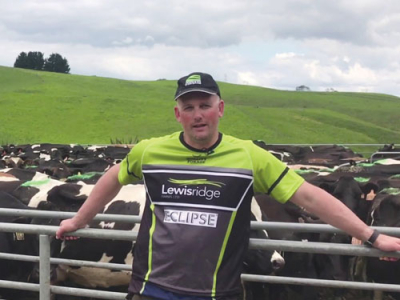 Chris Lewis.
One in five people interested in taking up dairy apprenticeships are from Auckland and one in three people placed in apprenticeships are women.
Those statistics were revealed as Federated Farmers marked the first anniversary earlier this month of its Apprenticeship Dairy Programme.
The pilot programme supported by MBIE, the PrimaryITO and Feds, was launched last year to find more Kiwis keen to work in the dairy industry on farms, and keen to upskill into a farming career.
Feds dairy chairman Chris Lewis says the apprenticeships are available in all areas where the Primary ITO has training, i.e. every province of New Zealand.
“This is primarily to get young and not-so-young New Zealanders to work on our dairy farms,” he told Dairy News.
They can register at www.farmapprentice.co.nz and will be contacted within a week.
“The employers have to go through a farm charter about certain standards; not onerous, but improving our employers and making sure they will look after our apprentices.
“And to make sure they want to train young New Zealanders and improve their skills and be great employers themselves.
“If they are just looking for a farm worker to work hard then this may not be the scheme. Our apprentices do work hard but we want employers who are like-minded and want to train the next lot of Kiwis who manage or buy our farms.
“On the apprentice side we don’t take everyone; we have rejected a few. The message is ‘if you want this apprenticeship you have to study hard, be a good employee and all those sorts of things.”
The scheme aims to create great farm managers, Lewis says.
“We want to take them from farm system level and make sure they get well educated and well-trained and take them from farm assistant to farm manager or herd manager.
“If we do that we will have achieved success in our minds.”
An apprentice who is good at the education side and really practical might get through in about two years, Lewis says. For someone who requires more of a helping hand, it is probably about two and a half.
Many more needed
While one in five of all people wanting to take up a dairy apprenticeship are from Auckland, many more will be needed where they came from, says Primary ITO chief executive Linda Sissons.
More than 40 people from Auckland have registered interest in the scheme. “It’s a good signal that dairying is a great career and starting out as an apprentice puts you on a premium pathway to leadership and even farm ownership,” says Sissons.
The dairy farming industry needs an estimated 17,000 new workers by 2025, and Sissons says with over 85% of New Zealanders living in urban areas, employers will be looking to the cities.
“We’re pleased to see that Aucklanders are interested in learning to be dairy farmers. When we launched the apprenticeship programme with Federated Farmers, we wanted to encourage smart, innovative and ambitious people onto farms. One year in, it’s great that people around New Zealand are seeing the benefits of a dairy apprenticeship.
“The benefits of a dairy farming career in the regions -- like affordable living and short commutes -- are obvious and there are real benefits to the regions too from people joining their communities.”
At this stage, about 60 people have started apprenticeships, mostly in Taranaki and Waikato.
Rural leader Mark Hooper has been appointed as an independent director to the NZPork board, bringing extensive farming, governance and advocacy experience to the role.

The terrible floods that hit the Wairarapa may have subsided, but the danger to farmers still exists, according to local Federated Farmers president Rob Hickson.
Will a stronger, more coordinated voice help rebuild confidence and improve returns in the wool sector?
New Zealand's pest problem has reached crisis point, according to Federated Farmers' second National Pests Survey, which shows farmers are spending more money and effort on control — yet pest numbers keep climbing faster than they were two years ago.
Despite political shenanigans in Wellington, farmers are confident that Resource Management Act (RMA) reforms will get over the line in this term of Parliament.



Now in its fourth year, the 2026 Fencing Industry Awards, formed part of the proceedings of the FCANZ Conference, held in Nelson during August.
DairyNZ deputy chair Cameron Henderson has been re-appointed unopposed for another term.
OPINION: The stats speak for themselves.
Farms across the upper North Island are trialling different pasture mixes as part of a research programme that aims to build greater resilience into farming systems.
Election years are always a concerning time for farmers, according to DairyNZ chair Tracy Brown.
The Ballance Farm Environment Awards are coming to the West Coast of the South Island.



OPINION: It seems Canterbury processor Synlait is still in the doldrums.
OPINION: Get offside with New Zealand First leader Winston Peters at your own peril.