BVD Control: Why One Measure Isn't Enough for NZ Herds
Bovine Viral Diarrhoea (BVD) remains one of the most significant infectious diseases affecting New Zealand dairy herds.




 increase font size
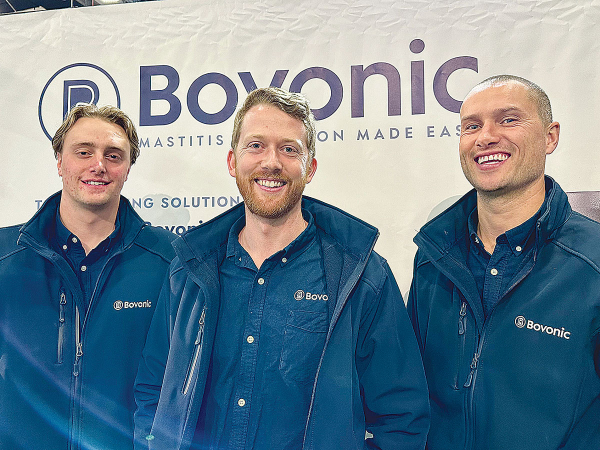 The Bovonic team who attended this year’s National Fieldays – from left Caleb Spencer (supply chain manager), Liam Kampshof (company founder), Tom Fitzgerald (business development manager).
Kiwi agri-tech start-up Bovonic, behind the mastitis detection technology QuadSense, has secured a $940,000 capital investment to help get it to dairy farmers sooner.
QuadSense is an inline, automated detection technology that the company says enables dairy farmers to quickly and accurately detect mastitis, one of the most expensive diseases affecting the global dairy industry.
“The interest and response from New Zealand dairy farmers for QuadSense has far exceeded our expectations,” says Bovonic founder Liam Kampshof. “The market is demanding a user-friendly, affordable solution to mastitis detection that’s easy to install and use and Quad- Sense is fulfilling these on-farm requirements.
“Since we first showcased our innovation in 2021, more than 450 farmers from all over the world have registered their interest in our product with 400 units already pre-ordered by New Zealand farmers,” says Kampshof.
“With the level of demand we’ve received, we made the decision to commercially launch the technology at this year’s National Fieldays rather than later in 2024.”
While other solutions are effective, for many farmers they are costprohibitive, according to Bovonic. It says DairyNZ, estimates other automatic mastitis detectors can cost as much as $3,000 per bail.
“Mastitis is a significant problem and can be a source of stress for farmers and their animals so there’s a lot to gain from detecting mastitis early. We’ve designed QuadSense to be accurate, fast, and easy to use, but at $500 per Quad- Sense unit, per bail, importantly it delivers an economically viable option for dairy farmers,” says Kampshof.
The capital round, which has been led by venture capital investor, Pacific Channel alongside Enterprise Angels, MIG Angels, and NZVC, follows an initial $750,000 investment from Pacific Channel.
“The capital will be used to ramp up production, accelerate sales and get QuadSense into the hands of dairy farmers faster, so they can take control of mastitis and protect their profitability and animal health,” says Kampshof. “It will also allow us to start building connections overseas so we can trial QuadSense in other markets.
“The venture investment in Bovonic reflects the real need for innovative technology solutions that can improve dairy farmers’ productivity and profitability. It also shows that we are delivering on our key milestones and there is a real potential for the technology to be scaled and have a significant impact on the dairy industry.”
Key initiatives Bovonic will prioritise with this new funding include the development of advanced features such as hygiene checks and integration with rotary milking systems. The funds will also be used to strengthen Bovonic’s market presence by installing Quad- Sense on more farms and showcasing its value to the wider industry.
While Bovonic remains focused on its current goals, the company acknowledges the potential for future investment rounds.
“We may seek additional funding next year to accelerate our international expansion efforts,” says Kompshof.
“Right now, our priority is Kiwi farmers and making sure they can get their hands on Quad- Sense as soon as possible.”
Bovine Viral Diarrhoea (BVD) remains one of the most significant infectious diseases affecting New Zealand dairy herds.

Bovine Viral Diarrhoea (BVD) is sometimes viewed as a dairy industry issue, but the reality is that the disease can have serious consequences for beef breeding herds as well.
When Simon Hales discovered triple drench resistance on his Weber farm, it was a catalyst to fast-track farm system change.
Body Condition Score (BCS) is a critical element in managing the health and reproduction of the dairy herd.
Bull management involves ensuring the right number of healthy bulls for your herd, minimising stress and reducing injury risks.


An Auckland gelato shop and an established New Zealand ice cream maker have both been named Supreme Champions at the NZ Ice Cream & Gelato Awards 2026.

As the cost-of-living crisis continues to put pressure on household grocery budgets, new figures show pork remains one of the most affordable fresh meat options for New Zealand families.
OPINION: In politics, credibility is and should be big. It must surely rank higher than charisma, which is quite trite and superficial. Yet, voters nowadays are often wooed and influenced by how someone looks or talks at a superficial level. TV plays a huge role in this.
Farmers can spend less time on paperwork, thanks to a new data sharing agreement between DairyNZ’s DairyBase and LIC’s MINDA software.
Kaikōura families affected by July's severe storm have found a practical solution to a problem that's kept some children away from regular schooling for weeks: a washed-out section of Inland Kaikōura Road, which has stopped the local school bus from running its usual route.
Rural New Zealand is welcoming the Government’s recent package of rural healthcare initiatives.

OPINION: After hogging the media limelight for telling a NZ Chinese MP to "go back home", Winston Peters has decided…
OPINION: With fuel prices soaring, one would have expected most farmers to be reclaiming excise duty on petrol.