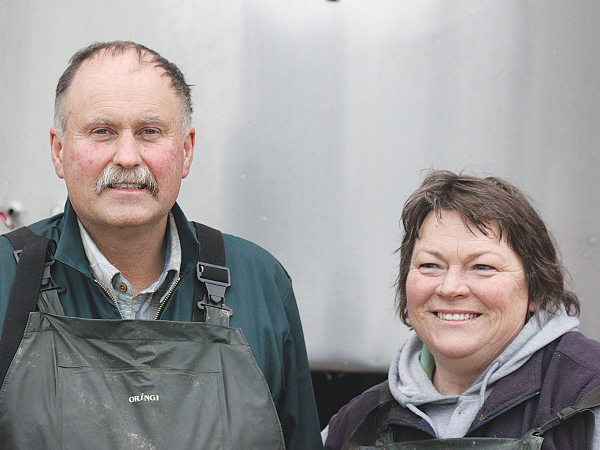
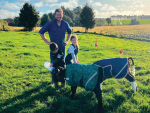
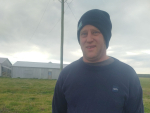
Gore dairy farmers Doug and Josephine Dodds are leading their 111-year-old family farm into the future by combining established genetics with more efficient farming infrastructure.
The 200ha farm, on which the Dodds’ milk 450 Holstein Friesian cows producing 400 kgMS/cow, was established by Doug’s grandfather in 1911 under the name Middlevale Stud; Doug is the third generation to farm the property.
After high school, Doug spent four years at Lincoln University completing an agricultural degree before returning to the home farm and going into partnership with his father, Ian Dodds, milking year-round to supply town milk for “So Fresh” based in Invercargill. Doug eventually took over the farm, and in 1992 married Josephine and together carried on the partnership. They have since moved to seasonal supply with Fonterra.
Josephine also comes from a dairy farming background, but from near Dargaville, Northland, where her parents farmed Ayrshire cattle.
Today, the farm is a pasture-based system with some pasture silage fed as well. Further supplements are used sparingly when required. Cows are wintered inside throughout the cold Southland winter.
The herd calves at the end of July, finishing in the first week of October, with mating starting shortly after. The herd completes 10-11 weeks of AI undertaken by Doug himself, an AI technician. They also artificially inseminate the heifers for one round.
When selecting bulls, Doug sets some minimum requirements.
“We look closely at fertility and Somatic Cell Count (SCC), ‘red carding’ any bulls that are low in these traits,” Doug says.
“If they are high in these traits, it’s a bonus. Our current focus is total capacity, udder overall and protein BV. We may change our focus in the future, depending on what’s required.”
The most heavily used bull in the herd is San Ray FM Beamer-ET S2F, who is producing good, allround milking cows.
“Beamer daughters are quick to come in and milk, and they mature young,” Doug says. “Their udders are more on the average side, but they are willing workers and very capacious.”
Other bulls selected for this season’s mating include Lightburn Blade Gusto, Rivendell MFU Scotch, Meander Shot Alibi-ET S3F, No-Fla Dijon 42649-ET, Busy Brook Overdraft S2F and Aprilday 602 Riptide- ET.
The Dodds’ ‘B’ cow family stand outs in the herd, descending from a cow born in 1912 that Doug’s grandfather owned.
“A few decades ago, we were also quite heavily influenced by the Pukeroro Stud in the Waikato,” Doug says.
“We got a few cow families from that stud.”
Middlevale has a long association with CRV, with Middlevale cows and heifers selected annually for planned matings over the years. In the 2022-23 season, four females have been selected.
Middlevale Baron Pablo, breeder proven son of Wenron Baron, entered CRV’s Sire Team in its early years and was used extensively in the late 1970s. Other bulls catalogued include Middlevale TEF Zulu S3F, Middlevale MOF Mohican, and Middlevale Minte Brave, who was selected as part of the Genetic Leaders joint venture programme.
Doug and Josephine are regular classifiers of their cattle, which Doug says is useful for providing information when selling or purchasing stock.
“The change to linear assessment has made the process more objective,” he says. “Conformation is an important feature in improving dairy cows.”
Doug says he has only ever worked with the Holstein Friesian breed, but from what he has been told by other farmers he believes they are easier to rear, easier to manage, and have the highest production of all breeds on an individual basis.
“With labour costs rising, a cow that produces well becomes more profitable,” Doug says. “Holstein Friesian cattle are very versatile; they are also a good fit for dairy beef.”
Farm Facts
Owner: Doug and Josephine Dodds
Location: Gore
Farm Size: 200ha
Cows: 450 Holstein Friesian cows
Production: 400 kgMS/cow
Stud name: Middlevale