Fonterra Elections 2026: Voting Opens Tuesday 20 October
Fonterra shareholders can begin voting on Tuesday 20 October in the 2026 Board of Directors’ election, a Co-operative Council election in one Ward, and seven Annual Meeting resolutions.




 increase font size
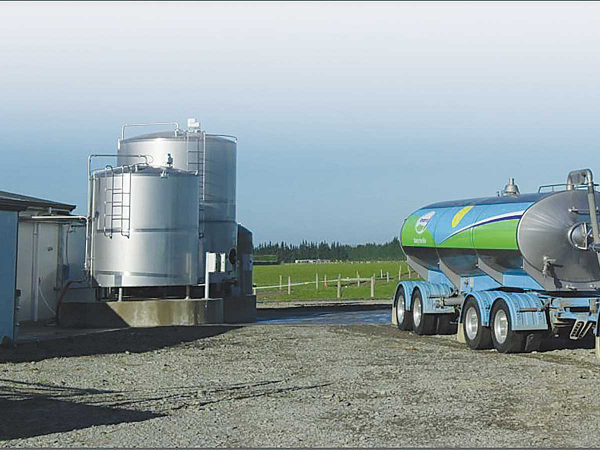 Fonterra is installing a new vat monitoring system on its supplier farms.
Fonterra is continuing a roll out of its new milk vat monitoring systems.
The new systems will support their farmers’ production of high-quality milk and make the co-operative’s milk collection more efficient.
The co-op says the milk vat monitoring systems are part of Fonterra’s commitment to help make farming easier.
According to Farm Source, the rollout started in Canterbury, Tasman and Marlborough districts late last year.
The two-year programme ends with installations in Taranaki and Central Districts next year.
Farmers will be able to choose the type of monitoring solution that best suits their farm. The co-op will cover the cost of the base model and farmers can choose to upgrade and pay their chosen solution provider directly for any extra features.
HALO, Levno, and DTS have been approved as milk vat monitoring system providers. Fonterra is also working with other providers to understand whether their solutions are compatible.
Fonterra undertook a pilot programme last season with approximately 80 farms in the Waikato and Canterbury. The feedback received helped to validate assumptions about the benefits that could be realised by both farmers and the co-op.
Farmers who participated in the pilot say it helped them make more informed decisions and address issues quickly.
“I have been farming for 34 years and this makes life easier for both workers and relief milkers. Especially the notifications when the vat chiller has been left off,” says Tirau farmer Adam Wainman.
Winton farmer Peter Hancox says he’d definitely recommend the system to others and Geoff Stevenson, who farms just outside of Christchurch, says the technology was easy to use.
“Really good system, good for watching temps. I’m not a computer buff but easy enough to access,” Geoff says.
Richard Allen, head of Farm Source, says there will be benefits for both farmers and the wider co-op.
“The technology will help farmers make more informed decisions and address issues, quickly helping them to avoid lost milk or grades. By avoiding grades, farmers will also be a step closer to achieving recognition, including Farm Source Reward Dollars, under The Cooperative Difference.
“For Fonterra, the milk vat monitoring systems will help improve collection efficiency as it will provide more precise information about available volume and milking time.
“This will also save farmers time: they will no longer need to manually update their milking time window throughout the season.”
One month after installation on-farm, milking time windows will begin to be calculated using a rolling monthly average determined by the milk vat monitoring system. Farmers will no longer have to manually update their milking times and Fonterra’s collections will be more efficient.
Fonterra needs a certain level of volume accuracy in order to deliver the collection efficiencies. Many existing systems do not have volume or at the level of accuracy needed. On-going collection efficiencies will result in savings that will fully cover the cost of this new technology.
There will also be benefits of improved milk quality and flexibility in consistently being able to make products that meet customer specifications.
Allen says this kind of support and innovation is another benefit of supplying the cooperative.
“Our co-op sets out to deliver the highest sustainable return to our farmers every day. If we can help our farmer-owners produce the best quality milk, and then transport and process it in the most efficient way, it all adds up to the return we deliver to our farmers and their co-op at the end of the day.”
In addition to the volume and milking time information, Fonterra will also receive a Milk Quality Indicator (farms will also receive this). The Milk Quality Indicator is an estimate of the bacterial level in a vat based on the milking time and temperature data.
The Milk Quality Indicator (MQI) is determined by a theoretical model using the volume, agitation, and temperature profile.
Fonterra says the MQI will inform their discussions with farmers to improve milk cooling systems and milk quality where necessary.
Starting September 2021, once all farms have a base model installed and have had time to review their MQI, Fonterra will use the MQI to inform testing. At first this could lead to more grading and demerits as farmers adjust and improve their systems to meet the standard Terms of Supply.
The application of milk cooling grades will continue to be based on the tanker temperature at time of collection but will be based on the more precise milking times.
For example, if the tanker arrives to collect the milk and the temperature as assessed by the tanker is not at the appropriate temperature, the farm may receive a grade as per the current Terms of Supply.
Fonterra shareholders can begin voting on Tuesday 20 October in the 2026 Board of Directors’ election, a Co-operative Council election in one Ward, and seven Annual Meeting resolutions.

Fonterra Co-operative Group chief financial officer Andrew Murray has resigned to take up a role outside the dairy giant.
Four candidates have been confirmed for two director positions on Fonterra’s board.
A record farmgate milk price and strong global demand is laying the foundation for continued growth of organic dairy farming in New Zealand.
Waikato milk processor Tatua has again declared a record milk payout to farmer shareholders, leaving other processors in the dust.



Federated Farmers has welcomed new rural policies released by ACT, saying they align closely with its own election priorities.

Rural Contractors NZ says proposed changes to land transport rules for agricultural vehicles are a welcome response by the Government to out of date regulations which have seen members hit with huge fines.
Alliance is calling for final applications for its 2027 Graduate Programme, with applications closing on Sunday 25 October.
Decades piloting planes has ensured vet and farmer David Hayes is focused on safety. So, after a serious accident while welding on farm, he is sharing his experience so others can learn from it.
Canterbury milk processor, Synlait Milk has confirmed Leon Fung as its chief executive officer.
OPINION: Making it easier to collect rainwater and use it to grow crops and livestock is a no brainer.

OPINION: It seems Canterbury processor Synlait is still in the doldrums.
OPINION: Get offside with New Zealand First leader Winston Peters at your own peril.




