Don't get caught short - have enough feed in the bank
OPINION: Few things are more stressful for dairy farmers than running out of feed when cows need it most.




 increase font size
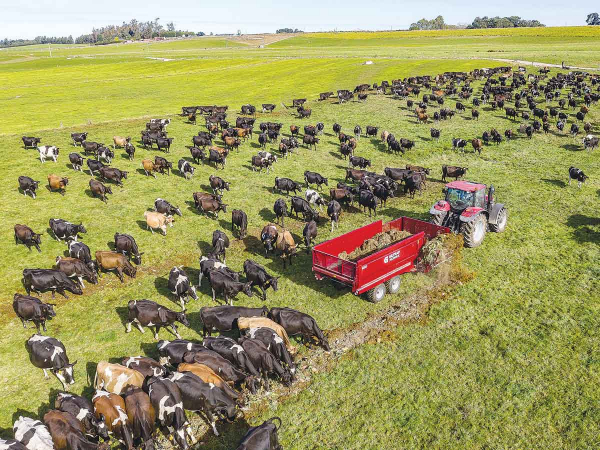 Giltrap Engineering's Multi-Feeder Plus.
Giltrap Engineering says its Multi-Feeder Plus offers users a wider range of feeding options.
Numbered 4B, 5B and 6B, the model numbers indicate the capacity in six-foot diameter rounds or seven-foot long square bales, with overall capacities of 13, 15.5 and 18 cubic metres, or 8700, 10,400 or 12,000 kg.
Described as a multi-purpose machine, offering the ability to handle chopped silage, square bales, roto-cut bales and beet, the MP should be interesting to farmers that have diverse feed sources or might wish to diversify in the future.
Featuring a one-piece tub built from Hardox steel, offering strength with reduced weight, the tub sides are one-metre high, allowing square bales to be stacked two-deep, without the need for “greedy boards”, so reducing the number of trips/loads per day.
In the base of the machine, the larger units are fitted with four ten-tonne-capacity floor chains (two on the 4B model) operating in a recessed channel, allowing the RHS, bolted slats to sit flat on the floor and resist bending. The rear tailgate is fitted with an auto-release system, allowing it to open if a load is reversed too far.
Up front, the feed-out chamber takes material from the main tub, then moves the material to the unloading elevator using RHS bars carried on a 3-inch pitch chain, with a 15,000lb load rating, said to be the heaviest in the industry.
A load-sensing valve automates feed-rate control to the hydraulically adjustable, tilting elevator on the right side of the machine, with a design layout seeing it extending under the floor to minimise spillage. On the left side of the feed-out chamber, a deflector plate allows feeding to the left for forage or beet, with the option of a shredder unit.
The driveline of the feeder uses hydraulics throughout, with the need for three double acting remotes, which in turn power the main bin floor, the feed chamber conveyor and the unloading elevator. The drive to the motors is direct, removing the need for more typical intermediate chain drives, a potential wear point.
At the front of the unit, a perforated bulkhead allows the operator to have good visibility of the load, while a drawbar-mounted bin is an ideal receptacle for waste twine, net and bale wrap. Ease of access sees full length handrails and tread plates on each side of the machine, while daily maintenance is helped with the grouping of grease nipples into easily accessed banks.
Keeping things mobile falls to an oscillating-beam tandem axle layout that uses up to 90mm section steel dependent on models, in turn carrying 8-stud wheel equipment fitted with wide flotation tyres.
Standard equipment includes LED lighting, while an extensive list of options includes hydraulic braking, a multi-point electronic weighing system with digital display, joystick controls and a remote axle greasing system.
OPINION: Few things are more stressful for dairy farmers than running out of feed when cows need it most.
Cows ingesting metal objects in conserved feed is typically going to end in tears, quite often with a trip to the knacker’s yard.
Imported and distributed by Giltrap Agrizone in Cambridge, Hi-Spec slurry tankers and manure spreaders are offered in several ranges to suit farmers and contractors.
Successful calf rearing starts at the beginning and getting it right will always be important in setting them up for the future, says calf feeder maker Stallion Ltd.
Giltrap Engineering says its Multi-Feeder Plus offers users a wider range of feeding options.



Pāmu has released its FY26 Integrated Annual Report, reporting a Net Operating Profit of $113 million, more than double the $49 million recorded in FY25.

Meat Industry Association data, released alongside the Red Meat Sector conference in Wellington, shows export value climbing across the US, China, UK and Canada.
Applications are set to open for the 2027 Zanda McDonald Award, a trans-Tasman award recognised for identifying and fast-tracking talented young leaders in agriculture and agribusiness.
The Royal New Zealand College of General Practitioners (the College) and Hauora Taiwhenua Rural Health Network are calling for investment in a proposed new training pathway for rural GPs, warning that many rural practices are struggling to recruit while a large share of the existing workforce nears retirement.
Federated Farmers has called on Central Otago District Council (CODC) to drop or vote down a plan to truck sludge from Alexandra and Cromwell to farmland near Lauder, warning it would compound an "outrageous" situation created by a separate council's decision weeks earlier.
Synlait has swung to second-half profit as operations stabilise, but the dairy processor still posted a $75.4m annual loss.



OPINION: It seems Canterbury processor Synlait is still in the doldrums.
OPINION: Get offside with New Zealand First leader Winston Peters at your own peril.




