
Boosting Crop Production by Spreading Effluent
Tararua district farmer Jamie Harris milks around 400 cows using a split calving system on his farm, Crossdale Dairies.




 increase font size
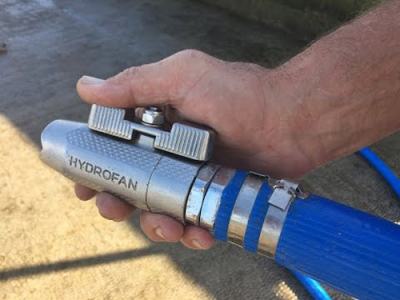 Hydrofan washdown nozzle.
A farm dairy effluent system must collect all animal excreta deposited in contained areas, plus any other liquid or material coming into contact with it, says system designer Numedic.
Not just the milking shed, but any stand-off areas, feed pads, housing areas and stock underpasses where effluent collects, must be serviced.
The industry’s calculated average is 70L/cow/day. But Numedic director Catherine Reid says this figure includes an animal manure component of only 10L/cow/day; the other 60L is mostly water from washdown, backing gates and cleaning.
“If we can reduce this volume of water we can lower the cost of electricity used in sourcing the water, using it in the cowshed and pumping it as effluent,” says Reid.
To reduce the volume of effluent needing to be pumped or stored requires finding ways to improve water use efficiency.
One such way, the company says, is its Hydrofan washdown nozzle. In an average size herd of 400 cows the nozzle can save 1.2 million litres of water per year.
“This automatically also means power savings so farmers can keep more money in their pockets,” says Reid.
The ‘secret’ of the Hydrofan nozzle is its patented water jet orifice and angle which improves water efficiency and mostly is faster in yard washing. The nozzle produces a sharp, stable stream with high impact using less water.
Nozzle trials by Northland Regional Council have shown 20-70% in water savings, Reid says. More trials are now underway on South Island farms jointly with Environment Canterbury.
“The general feedback from users is that the nozzle also achieves the yard washing faster,” Reid says.
Numedic is an accredited designer of farm dairy effluent systems.
Tel. 0800 686 334
Tararua district farmer Jamie Harris milks around 400 cows using a split calving system on his farm, Crossdale Dairies.
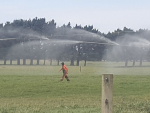
Water management is an integral component of sustainable farming practices, according to Watermetrics.
Two farmers and two farming companies were recently convicted and fined a total of $108,000 for environmental offending.
A Taupiri farming company has been convicted and fined $52,500 in the Hamilton District Court for the unlawful discharge of dairy effluent into the environment.
Founded in Germany as recently as 1977, today, the Fliegl Group employs more than 1100 workers, offering an expansive range of transport solutions, from their base in Bavaria.


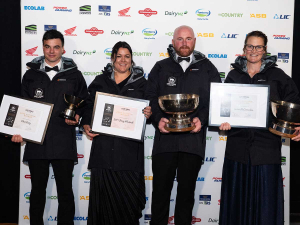
Entries opened on Monday, 5 October 2026 for the 2027 New Zealand Dairy Industry Awards (NZDIA), which organisers describe as the nation's biggest celebration of excellence in the dairy sector.
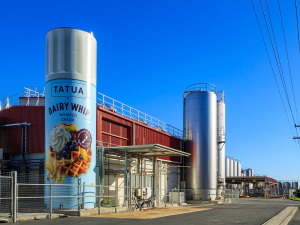
Waikato milk processor Tatua has again declared a record milk payout to farmer shareholders, leaving other processors in the dust.
A Labour-led Government won’t be bringing back the controversial freshwater rules of 2020.
National’s much-touted free trade deal with India featured in the Rural Issues Debate at Mystery Creek, Hamilton on Wednesday night.
New Zealand's 2026-27 freshwater fishing season has opened, with anglers encouraged to head to rivers and lakes over the coming days as conditions look favourable across much of the country.
Central Otago District Council (CODC) has voted against a plan to spread treated sewage sludge from Cromwell and Alexandra on farmland near Lauder, a decision Federated Farmers says reflects strong opposition from rural residents.



OPINION: It seems Canterbury processor Synlait is still in the doldrums.
OPINION: Get offside with New Zealand First leader Winston Peters at your own peril.




