Research shows farm ownership a viable goal
Buying a farm is challenging but still achievable according to research recently carried out by Smaller Milk and Supply Herds (SMASH).




 increase font size
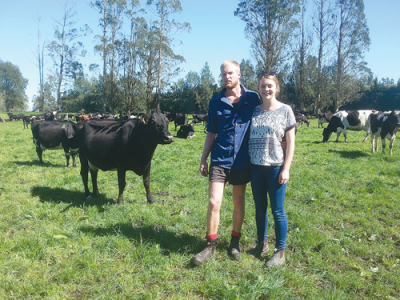 Waikato sharemilker Markus Woutersen and partner Taylor on their farm.
Markus Woutersen has just begun his dairy career but his low cost operation is already attracting industry attention.
He’s in his fourth season, sharemilking 285 cows on the family’s 98ha effective farm near Cambridge, Waikato.
He says that his father built an efficient farming operation, allowing him to focus on ironing out the kinks.
“The building blocks were in place when I arrived, but there is still lots of potential on this property. Our output is already pretty good, about 1350kgMS/ha, but over the next few years I believe we will be able to reach 1450kgMS/ha.
“In my first three years as a sharemilker our working expenses have ranged between $1.10 and $1.26/kgMS. One of my goals is to cap costs at $1 to $1.10 by further increasing efficiency, pushing production while maintaining a low cost base. This gives you options; even with the current payout we can still do all right.”
Woutersen closely watches all costs; his emphasis on buying in minimal amounts of supplement and skilfully managing pasture, are playing a big part in his success.
“We are aiming to get upward of 450kgMS/cow. We calved early in spring (June 28 this year) with high covers -- our goal is over 2500kgDM/ha at planned start of calving -- and use PKE when required to fill any gaps. Then we go all-grass from balance date until summer, when we get back in with the homegrown maize silage and fodder beet. Our aim is to have a long lactation with a long, flat peak. The cows generally peak in August and just sit there.”
Woutersen’s passion for farming dates back to his childhood. “I have always wanted to farm this farm, that’s been my dream,” he says. “I used to milk on farms in the district after school and in the weekends. I was paid well for doing it, so the people who employed me helped set me up.”
Woutersen believes smaller herds like his one play an important part in the industry, although the definition of small may be changing.
“Small herds hold a great place in society and in the community, and they will continue, although what small is may be redefined. They are probably the most resistant to low payouts, and the most resilient to volatility, because they often have lower debt levels and they are chiefly run by owner/operators, who generally run them to a high standard.
“[I like] being small enough to enjoy farming, knowing the cows personally, but being big enough to have some flexibility and being able to delegate some tasks. My ideal farm is one big enough to have one person working with you.
“You gain more skills on a smaller farm than on the big farms. We fix most things ourselves, which keeps costs down and also adds some variety to our day. You are better for it if you can help yourself.”
Woutersen has a thirst for knowledge and is a firm believer in the benefit of getting off the farm to learn, from agricultural professionals and other farmers. That is where SMASH fits in.
“I came to the winter SMASH conference at the end of my first season,” says Woutersen. “It was really good. Since then I have attended a few field days and workshops. The days are well organised.
“I have always liked learning about farming and how to do things better, and going along to events can be quite interesting; when there are good guest speakers, everyone learns a lot.
“It is a good chance to get off the farm, have a chat with mates, or make new contacts, and see how other people are going. Sometimes if things aren’t going as well as you would like, talking to others gives you a bit of comfort as often everyone is experiencing the same difficulties.
“The SMASH lunches are always good, which is essential; if you have a good lunch break it gives you the chance to talk to people. The events provide a great opportunity to network; I enjoy meeting and talking to people. The collaboration in the industry is awesome; farmers are happy to share experiences.”
He is also willing to put his own operation under the microscope as he believes it is an excellent learning opportunity. This led to him agreeing to host a SMASH field day.
“The day here was well put together by the SMASH committee and their sponsors; everyone enjoyed it. The feedback was good and the questions I had to answer made me think. I like the opportunities where you have to push yourself, the personal development, and get quizzed on what you are doing. It either gives you ideas about how to do things better, or shows you are doing the right thing.”
• Louise Hanlon is an executive committee member of Smaller Milking and Supply Herds (SMASH).
Buying a farm is challenging but still achievable according to research recently carried out by Smaller Milk and Supply Herds (SMASH).
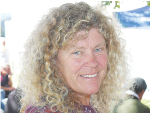
Anna Kalma is Smaller Milk and Supply Herds (SMASH’s) national coordinator and has seen it all in her time on the national committee.
Smaller Milk and Supply Herds (SMASH) needs your help.
A top farm accountant says in the present downturn, it's vital that farmers take heed of all the good advice on offer.
Michael Kiernan's lucerne crop was a godsend in the dry Southland summer this season.


Farmgate lamb prices are down by 8%, beef cattle by 4.5% and farm expenditure up by 4.2%.
Kiwifruit growers are watchful but remain optimistic as concerns around the potential effects of the El Niño weather pattern this season.
Almond hulls sourced from Australian orchards may have the potential to help New Zealand cows reduce emissions, boost milk yield and lower input costs.
Striking a balance between meeting the needs of industry to speed up approval time for products but on the other hand ensuring that risks are properly assessed.
Surprised, humbled and quite thrilled. That’s the reaction of James Allen, one of the founding partners and now chief executive of AgFirst, on being made a life member of the Institute of Rural Professionals.


OPINION: It seems Canterbury processor Synlait is still in the doldrums.
OPINION: Get offside with New Zealand First leader Winston Peters at your own peril.