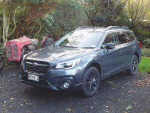
X marks the spot
While many car manufacturers set out to cater for all sectors of the market, it’s fair to say that Subaru has “stuck to its knitting”.




 increase font size
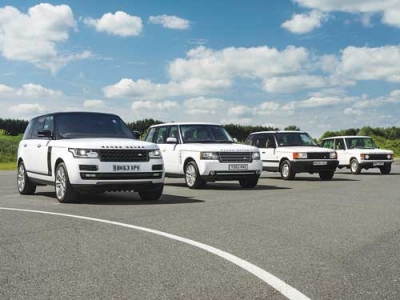
Back in 1970 we were wearing tank-tops, tie dies and platform shoes, and mirror must have been in short supply, but the year marked the birth of a motoring genre that has just reached its 45th birthday.
Back then the term SUV hadn’t been dreamed up, but today it forms a huge part of the new car market around the world.
1970 saw the birth of the Range Rover, which had rural folk thinking the motoring industry had gone mad. Who would want a huge box-like vehicle with permanent four wheel drive, big petrol guzzling engines and large leather seats? Surely it’ll never catch on?
But it did, spawning a generation of luxury four wheel drives that sat people higher, gave them a feeling of safety and took the curbs of suburbia in their stride.
In its 45 years the Range Rover has seen four evolutions, and history will record it achieving a number of firsts. So much so that the incarnation referred to as the Range Rover Classic was the first vehicle to be shown at the Louvre in Paris , with a citation that recognised “an exemplary work of industrial design”.
But the beauty wasn’t just skin deep. The RR was the first vehicle to complete the 18,000 mile Trans-American Expedition, won the London to Sydney Marathon in 1977, and the inaugural Paris Dakar Rally in 1979.
Today’s Range Rover is a far cry from the 1970s original; it has an all-aluminium body shell, can be specced with engines up to 550hp, and continues to push the technological boundaries with features like the recently launched All Terrain Progress Control (ATPC), which controls slow speed over difficult ground while the driver steers.
And after 45 years it still has the desirable name, still has the looks and still is the place to be if you want comfort and luxury.
While many car manufacturers set out to cater for all sectors of the market, it’s fair to say that Subaru has “stuck to its knitting”.

Just why is the Suzuki Vitara so popular in New Zealand? Mark Daniel found out as he test drove the new 2019 2WD turbo.
A new entry-level Range Rover Velar is set to be the model Kiwi motorists can better afford.
With the compact SUV sector making up 20% of the total SUV market, it’s not surprising to see Toyota launching a new model to claim its share.
When you tell your golfing buddies that you’ve just come back from the launch of the Range Rover Velar, they ask, “What sort of name is that?”



National’s much-touted free trade deal with India featured in the Rural Issues Debate at Mystery Creek, Hamilton on Wednesday night.

New Zealand's 2026-27 freshwater fishing season has opened, with anglers encouraged to head to rivers and lakes over the coming days as conditions look favourable across much of the country.
Central Otago District Council (CODC) has voted against a plan to spread treated sewage sludge from Cromwell and Alexandra on farmland near Lauder, a decision Federated Farmers says reflects strong opposition from rural residents.
Pāmu has released its FY26 Integrated Annual Report, reporting a Net Operating Profit of $113 million, more than double the $49 million recorded in FY25.
Meat Industry Association data, released alongside the Red Meat Sector conference in Wellington, shows export value climbing across the US, China, UK and Canada.
Applications are set to open for the 2027 Zanda McDonald Award, a trans-Tasman award recognised for identifying and fast-tracking talented young leaders in agriculture and agribusiness.



OPINION: It seems Canterbury processor Synlait is still in the doldrums.
OPINION: Get offside with New Zealand First leader Winston Peters at your own peril.




