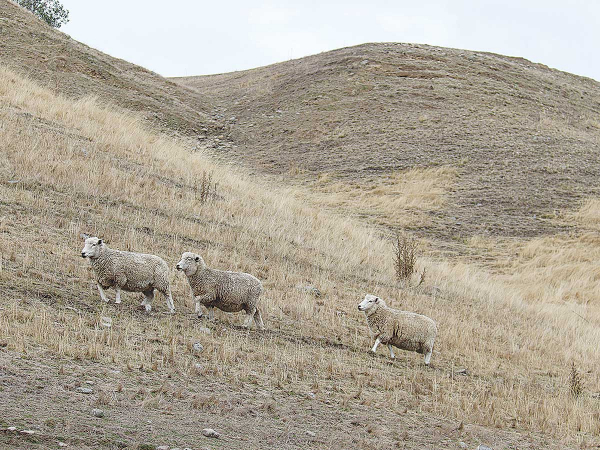
Many parts of the east coast of the North Island - especially from Wairoa down to Central Hawke's Bay - are in a crisis state with a severe autumn drought. Peter Burke drove through the area last week and reports that streams and springs are drying up and sheep in some places are struggling to find anything green.
Driving south from Gisborne, pastures are a real mixed bag - some good, some just okay and others looking scruffy and terrible.
In some cases, brown, not green, is the dominant colour and on closer inspection the ground is bare - with sheep moving restlessly across hillsides desperately looking for tucker.
AgFirst consultant Lochie MacGillivray told Rural News the situation for many farmers is bad with soil moisture levels where they were a year ago when there was major drought. He says there has been about 20mm of rain, but to get things back to anywhere near normal, at least 50mm is needed and the chances of that happening is, at best, about 50%.
"Some of the farmers are telling me their stock won't bounce back because the soil moisture is well below stress point. Farmax growth models are predicting 5kg growth rates in 10 day's time, but that is pretty low for this time of the year and we'd be hoping to do 20kg. So, what we are seeing is a quarter of normal growth rates."
MacGillivray says farmers have also been telling him that some of the springs are running really low and haven't really got back to where they were before last year's drought. He says, at one stage there were potentially problems with a lack of stock water. However, with winter approaching this is becoming less of an issue.
"But the water tables are really low and streams are low and slowing right down," he adds.
Despite the drought, MacGillivray reckons stock is in quite good condition and farmers are destocking but not panicking. He says, typically, they may draft at say 42kg, but many are now drafting at around 38kg.
MacGillivray says much has been learned by farmers with the past and present drought and one of the take-home messages is that farmers have to 'wire in' plans to deal with the horrible autumns that appear to be here to stay.
TB Issues Emerge
Lochie MacGillivray told Rural News a major problem that has also emerged is a group of about 15 farms in the north west of Hawke's Bay, around the Napier Taupo road, having a serious TB problem.
"They are store stock people and are not able to move animals," he explains. "The regulations for Ospri are different to what happens under M. bovis - so there is no compensation for them not being able to move their stock."
MacGillivray says the local Rural Advisory Group has discussed the issue and is looking at finding a way to help the affected farmers. He says MPI is also aware of the problem.