
NZ Apple Sector Pushes for Japan & Korea Market Access
The apple sector is working with the Government to unlock access to two key markets that could bring millions in revenue for apple growers.




 increase font size
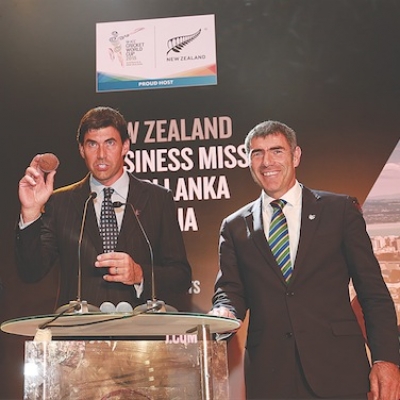 Stephen Fleming and Nathan Guy at a business function in Colombo.
A STALLED free trade agreement (FTA) with India has been kicked into life again.
This is what Primary Industries Minister Nathan Guy believes after he led a business delegation there and met with the country’s new government. The next step is for officials to get together soon and hold the tenth round of negotiations.
The agricultural trade target in India is premium food and beverage to the growing 300 million middle class. There are also opportunities in sharing New Zealand expertise and technology.
“We have been negotiating a free trade agreement since 2011 and we’ve had nine rounds of discussion,” Guy told Rural News. “The tenth round has taken too long to get organised. I met my counterpart, agriculture minister (Radha Mohan) Singh, and we had a constructive meeting. He is keen to see the FTA advanced.”
Since recent elections the new government seems to have renewed enthusiasm for trade, he says.
“The tenth round looks like looking progressing very soon and there seems to be an appetite to get on with it. This market has huge potential, they know New Zealand, they like New Zealanders and they like our products and we will keep pushing hard to land a comprehensive FTA.”
India has a population of 1.2b population with 300 million middle class and growing. Half the population is under 25 years. Two-way trade between the countries is $1.1 billion and both countries acknowledge we should be doing more, says Guy.
“We have a strong historical connection to India. We have a commonwealth history and 155,000 Indians living in New Zealand, very much part of our culture. There are 35,000 visitors from India to New Zealand a year.”
Wood and coal are our main exports and there is opportunity to do more in food and beverage and in services. Some kiwifruit, apples and avocados are already going into India, although with high tariffs, so Guy says an objective would be eventual tariff removal.
Frozen lamb is also being exported through Quality New Zealand. “The opportunities are for premium quality New Zealand products so lamb is going in there frozen, but ultimately it would be going in chilled. We need to work on an open skies agreement with Air India and Air New Zealand.”
“Then there’s our IT, technology, processing and equipment, and we can further partner with India on refrigeration, post-harvest handling facilities and other technology.”
Dairy is challenging because India is the world’s biggest producer – 70 million farmers with on average two-three cows each – but also an opportunity because they are also the largest consumers.
“As their population grows they will need food imports, so that’s where NZ has an opportunity to pitch at the premium market.”
The apple sector is working with the Government to unlock access to two key markets that could bring millions in revenue for apple growers.

As expected, the US has launched a safeguard investigation into lamb imports, a move that could impact New Zealand sheepmeat returns.
New Zealand's red meat sector says it welcomes the Government's focus on trade ahead of the general election in November.
New Zealand red meat exports are booming but a pending decision in the White House, Washington D.C., could dent sheepmeat earnings.
Politicians calling for New Zealand to withdraw from the Paris Agreement on climate risk damaging two of our gold-plated free trade deals.


Almond hulls sourced from Australian orchards may have the potential to help New Zealand cows reduce emissions, boost milk yield and lower input costs.

Striking a balance between meeting the needs of industry to speed up approval time for products but on the other hand ensuring that risks are properly assessed.
Surprised, humbled and quite thrilled. That’s the reaction of James Allen, one of the founding partners and now chief executive of AgFirst, on being made a life member of the Institute of Rural Professionals.
It was billed as a chance for all the political parties to woo the rural vote, but question marks hang over just how effective this was.
Minister of Conservation Hon Tama Potaka has appointed Susan O'Regan as Chair of the Queen Elizabeth II National Trust (QEII) for a three-year term.
Red meat farmers are welcoming Labour’s plan to review the Emissions Trading Scheme and not to campaign on pricing agricultural emissions.

OPINION: The same mainstream media muppets that brought you Jacindamania in 2017 have been flat out pimping for the Opportunities…
OPINION: Your old mate reckons the atrocious way farmers in the UK are treated by their lords and masters in…




