Southland Farmers Named 2026 Sustainable Farming Ambassadors
Michelle and Tony Roberts didn't inherit the farming business they have today. They’ve built it from the ground up.




 increase font size
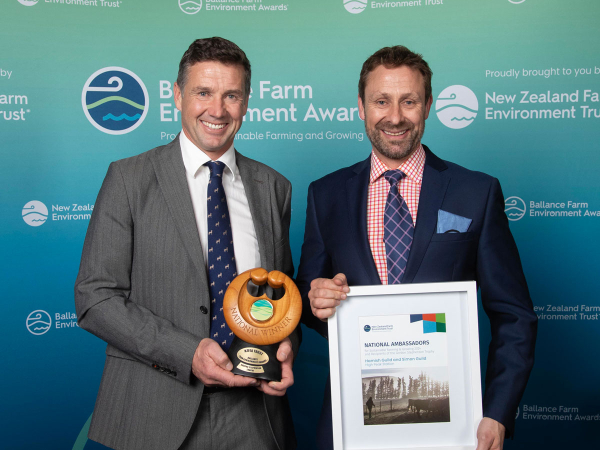 Hamish (L) and Simon Guild.
Hamish and Simon Guild of High Peak Station in Canterbury are the 2024 National Ambassadors for Sustainable Farming and Growing and recipients of the Gordon Stephenson Trophy.
This was announced last night at the National Sustainability Showcase at Claudelands Event Centre in Hamilton.
High Peak Station has traditional farm roots, however it has diversified in recent years to include a wide range of income streams.
The 3,760ha (3,450ha effective) property is managed by an eight-way partnership that runs four different businesses. The partnership comprises the Guilds – James, Anna, Hamish, Gemma, Simon and Kate – and Amelia and Tom Dunbar.
There’s a strong focus on adding value to all the enterprises, with the team striving toward high-end products and experiences. High Peak Station’s income is derived from sheep, cattle, deer, honey and tourism. The separate entities operate in synergy with each family member bringing different strengths to the table, which has ensured a sustainable and robust business.
The Guild and Dunbar families won the Canterbury Regional Supreme Award in March, with Hamish and Simon representing the family in the national judging process.
The judging process for the Gordon Stephenson Trophy includes on-farm judging as well as a panel interview, with the trophy recipients displaying a combination of an exemplar farming operation – from a financial, social and environmental perspective – and the ability to articulate informed responses and insightful views on a range of pan-sector topics.
Chair of the National Judging Panel, Karen Williams noted the exceptionally high calibre of Regional Supreme Winners, and said it was a privilege to hear their stories.
“All of the stories were magnificent, and as a farmer you feel really proud listening to them explain what they do and why,” says Williams.
“Hamish and Simon gave articulate, succinct and well thought-out responses to all of our questions, and demonstrated a strong customer and market focus, with particular awareness of global markets and how our products are seen off shore,” said Williams.
“They have a strong focus on succession, with the idea of ‘making the pie bigger’ to ensure everyone in the family finds a niche and a place to operate together.”
Williams noted that the family’s approach to climate resilience stood out, particularly as they have experienced floods followed by drought. “They recognise that science will deliver some of the tools to help build resilience, such as adopting more weather tolerant pasture species; they have explored the vulnerabilities to their business in detail; and they have adjusted or enhanced infrastructure to ensure they’re adaptable to climate change and severe weather impacts.”
The National Judging Panel also commended the Guilds for their creative approach to health and wellbeing within their team and their involvement in the wider community. “This is a diverse, multi-generational farming family with lots of strings to their bow,” says Williams.
Alongside a theme of multi-generational farming businesses and ‘succession on show’ within this year’s Regional Supreme Winners, Williams noted there was strong commitment to enhancing biodiversity, a clear desire to reduce GHG emissions, and an emphasis on the value of telling our story as New Zealand food and fibre producers.
The National Sustainability Showcase event at Claudelands celebrated each of the ten Ballance Farm Environment Awards Regional Supreme Winners from across the country. Hosted by the New Zealand Farm Environment Trust, the event is held annually as the pinnacle of the BFEA programme, and connects primary industry representatives from across the sector.
Michelle and Tony Roberts didn't inherit the farming business they have today. They’ve built it from the ground up.
Brendan Attrill of Caiseal Trust in Taranaki has been announced as the 2025 National Ambassador for Sustainable Farming and Growing and recipient of the Gordon Stephenson Trophy at the National Sustainability Showcase at in Wellington this evening.
‘Just take the plunge’ - that’s the message from Hamish and Simon Guild of High Peak Station, Canterbury to anyone considering entering the 2025 Ballance Farm Environment Awards.
The winners of the Gordon Stephenson Trophy say farmers are doing better on sustainability than they give themselves credit for.
Otago sheep and beef farmers Steven and Kellie Nichol won the coveted Gordon Stephenson Trophy at the recent Ballance Farm Environment Awards. As such, they also become the 2023 national ambassadors for sustainable farming and growing.


New Zealand's citrus growers were challenged to build their future on the value embedded in their fruit rather than the volume they produce, at Citrus New Zealand's annual gathering in Gisborne on 17 September.
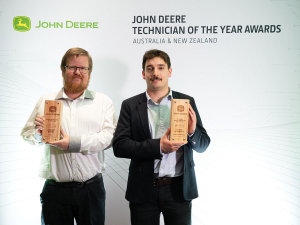
Leading John Deere technicians and apprentices from New Zealand and Australians were recognised at the recent sixth annual JD Technician of the Year Awards, held in Brisbane.
In Dacre, near Invercargill in New Zealand’s South Island, Bruce Dinnington is running a dairy operation unlike any other.
A free online platform aggregating governance vacancies across rural and regional New Zealand has been launched.
Environment Minister Nicola Grigg has announced details of a new rural plastics recycling scheme.
Agricultural drone operators say that a government decision to allow lower-risk drone work without certification won’t lower standards but drive innovation and efficiency.





OPINION: The same mainstream media muppets that brought you Jacindamania in 2017 have been flat out pimping for the Opportunities…
OPINION: Your old mate reckons the atrocious way farmers in the UK are treated by their lords and masters in…




