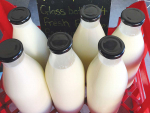
Recall to manage Listeria in raw milk
Raw drinking milk producer Real Milk Timaru is recalling specific batches of raw milk after routine testing detected traces of Listeria.




 increase font size
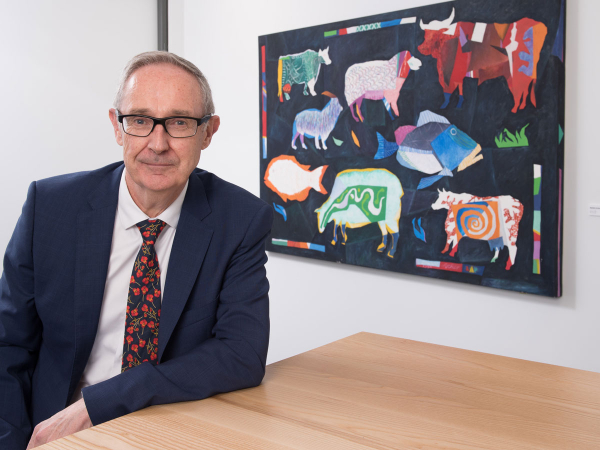 NZFS deputy director-general Vincent Arbuckle.
New Zealand Food Safety (NZFS) is sharing guidance to prevent people from contracting listeriosis, a rare yet life-threatening foodborne illness.
NZFS deputy director-general Vincent Arbuckle says that while listeriosis is rare in New Zealand, vulnerable people die from the preventable disease every year, "so we want to share some practical steps people can take at home to avoid getting sick".
Listeriosis is caused by eating or drinking food that has high levels of Listeria, a bacterium that is widespread in the environment. Listeria is invisible, has no odour and, unlike most bacteria, can continue to grow when food is refrigerated.
According to the most recent annual report concerning foodborne disease in New Zealand, there was a single death from listeria in 2024, down from 6 in 2022 and 7 in 2023.
“But even one death is one too many, so that’s why we are continuing our efforts to get those most at risk – pregnant women and older people – to better understand the dangers of listeriosis and what to do to decrease them," Arbuckle says.
Infections in healthy adults are unlikely to be severe, but listeriosis during pregnancy can cause miscarriage, premature labour, stillbirth, or disease in the newborn baby.
As you age - and particularly over 65 - your immune system gets weaker. This means foods you safely ate in the past may no longer be safe for you to eat.
“Some people may not be aware of this. So, we’re highlighting higher-risk foods while sharing some food-safety advice on how to make them safe to eat,” Arbuckle says.
Higher-risk foods include ready-to-eat meat products (e.g. deli meats and pâtés), smoked seafood, soft cheeses (e.g. brie, camembert), unpasteurised dairy products (e.g. raw milk), leafy greens and bagged salad (e.g. mesclun, spinach).
To lower the risk of contracting listeriosis, you can:
“NZFS requires food businesses to manage Listeria in the processing environment and to have strict measures in place to eliminate its presence in products,” says Arbuckle.
“If something goes wrong, we support food businesses with their consumer-level food recalls. In 2024, there were four consumer recalls due to the possible presence of Listeria," he adds.
He also suggests signing up to NZFS's food recall alerts at https://www.mpi.govt.nz/news/subscribe-to-mpi#subscribe-food-recalls
“Also look out for our current awareness campaign so you can share it with people who may not know the life-threatening risks. Let’s work together to not lose another person to listeriosis.”
Raw drinking milk producer Real Milk Timaru is recalling specific batches of raw milk after routine testing detected traces of Listeria.
OPINION: The company that makes dairy products under “The Collective” brand, and which copped a nearly $500,000 fine for failing to report positive listeria results, is turning to plant-based products as it makes a comeback.



LIC shareholders have elected a new North Island representative to the co-operative's Board, along with five representatives to its Shareholder Reference Group (SRG), following the company's Annual Meeting held in Invercargill.
Farmers across parts of Southland and South Otago are continuing to deal with difficult conditions after a prolonged run of wet weather, with pressure building around feed supply, stock management, pasture damage, farm infrastructure and everyday workloads.
Federated Farmers says it welcomes Labour's commitment to reviewing the Sharemilking Agreements Act, calling on other major parties to do the same.
For Canterbury dairy farmers Sian Meijer and Rick Wobben, wearable technology has become one of their most valuable on-farm tools - helping manage 1850 cows across an expansive, high-performing dairy operation while improving efficiency, mating outcomes and day-to-day decision making.
Fonterra has unveiled its annual results for the 2026 financial year, posting $27 billion in revenue and close to $20 billion returned to New Zealand farmer owners and unit holders.
The first major update to the Dairy Cattle Code of Welfare in more than a decade has been released, marking what DairyNZ describes as an important step in ensuring animal welfare standards continue to evolve alongside scientific evidence and on-farm realities.





OPINION: The same mainstream media muppets that brought you Jacindamania in 2017 have been flat out pimping for the Opportunities…
OPINION: Your old mate reckons the atrocious way farmers in the UK are treated by their lords and masters in…




