
Federated Farmers Backs Year 11 Agricultural Science
Federated Farmers is backing Feilding High School’s call to keep Agriculture and Horticultural Science as a standalone subject in Year 11.




 increase font size
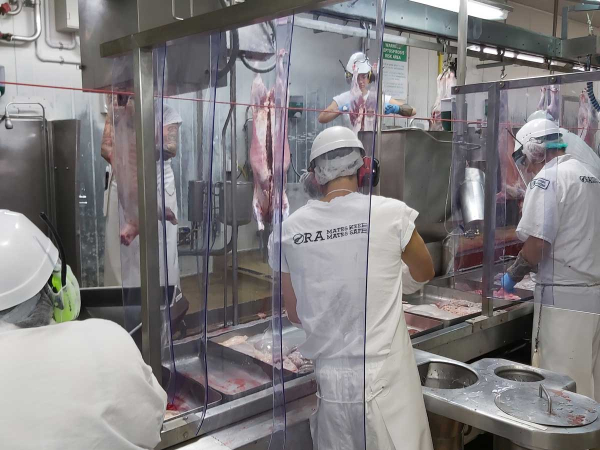 Meat companies are working hard to achieve normal processing capacity.
Farmers are hoping that processing capacity at meat plants will return to normal within a month.
Federated Farmers president Katie Milne says the meat companies are working hard to achieve normal processing capacity.
“The works assure us they are catching up fast and will be close to normal soon – sheep much sooner than beef,” Milne told Rural News.
“The North Island is further through their kill than the South Island. Hopefully by mid-June things will be near right again.”
Covid-19 meat processing protocols, which require physical distancing between employees to prevent the spread of the virus, reduced the industry’s processing capacity in level 4 by about 50% for sheep and lamb and 30% for beef.
Longer wait times, up to six weeks in some cases, put additional pressure on winter feed resources as farmers were forced to hold on to stock for longer.
Alliance chief executive David Surveyor has told farmers that the company is continuing to increase processing capacity across the network.
“Our plants are running overtime, extended shifts and at weekends,” he told suppliers in an email last week. “We are also transporting livestock from the South Island to the North Island to ease the pressure in the south.”
Surveyor says the co-op is on track to reach its Alert Level 3 target of over 90% capacity for ovine and over 95% for bovine across the network.
“The Meat Industry Association is working on a new processing protocol for Alert Level 2 and there is an expectation this will enable us to increase capacity further,” he says.
Meanwhile, Alliance will be offering a deer supply contract from July through to December 2020.
Surveyor says this will provide farmers with some certainty, helping manage risk during significant market uncertainty.
He says Alliance has been responsibly managing its inventory and sales.
“However, there does appear to be some inventory build-up in global markets and we expect this to impact sales prices in the short to medium term.
“We continue to have long term confidence in the deer industry,” Surveyor says.
Federated Farmers is backing Feilding High School’s call to keep Agriculture and Horticultural Science as a standalone subject in Year 11.
National’s pledge to introduce 19 new national standards shows the party is serious about getting Wellington out of farming, Federated Farmers says.
Mobile phone coverage and reliability are deteriorating in rural areas, and farming families are bearing the cost, according to a Federated Farmers survey.
OPINION: There could hardly be a more appropriate theme for a conference than the one chosen by the red meat sector - Navigating Volatility.
New Zealand's red meat and fifth-quarter exports reached $867 million in August, up 23% on the same month last year, as stronger returns lifted earnings across all major markets.


Decades piloting planes has ensured vet and farmer David Hayes is focused on safety. So, after a serious accident while welding on farm, he is sharing his experience so others can learn from it.
Canterbury milk processor, Synlait Milk has confirmed Leon Fung as its chief executive officer.
OPINION: Making it easier to collect rainwater and use it to grow crops and livestock is a no brainer.
As part of its Election 2026 coverage, Rural News asked political parties how they would help pull the arable sector out of the doldrums. Here's what they said:
Farmers are being encouraged to rethink how they manage waste on farm with the launch of ruralwastesorted.co.nz, a new website bringing together practical tips, real farmer experiences and resources.
New Zealand Winegrowers (NZW) is celebrating the India-New Zealand Free Trade Agreement (FTA) coming into force today, bringing New Zealand wine improved access to one of the world’s fastest-growing economies.

OPINION: The same mainstream media muppets that brought you Jacindamania in 2017 have been flat out pimping for the Opportunities…
OPINION: Your old mate reckons the atrocious way farmers in the UK are treated by their lords and masters in…




