Thursday, 20 September 2018 09:19

Only two regions disease-free

Written by 

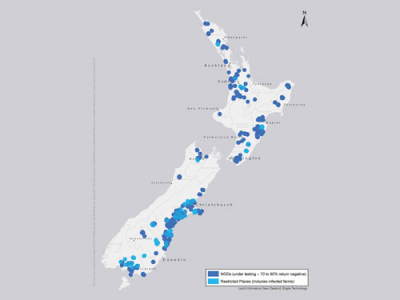
37 farms have been confirmed as infected with Mycoplasma bovis by the Ministry for Primary Industries — eight in the North Island and 29 in the South.

Twenty-one are beef farms, 14 dairy and two are “others.” Including those infected farms, 58 are now listed as ‘restricted places’. 

Notices of direction (NOD), which restrict some movement of stock from farms and are usually applied to farms where test results are pending, are in place on 190 properties.

A Biosecurity NZ map of the M. bovis spread indicates that only the Bay of Plenty and Marlborough remain free of the disease, with neither RP notices nor NODs in force.

Taranaki and the South Island West Coast have farms under NODs but as yet no confirmed infection. MPI says 70 - 80% of NODs do not go on to prove infected.

Meanwhile, MPI says eradication continues, with 30 farms now cleaned and depopulated and free to resume operation with new stock.

Simple steps

MPI is calling on farmers to adopt robust biosecurity practices. Simple steps farmers can take include:

- carefully consider the disease status of new stock before animals are bought or moved

- ensure visitors clean and disinfect their equipment, clothing and footwear on arrival at a farm

- make boundary fences secure and prevent nose-to-nose contact with neighbouring stock

- give young calves special protection, allowing only essential people into the calf shed.

More like this

Third H5 Bird Flu Case Found in NZ Wild Bird

Testing confirms H5 bird flu in a single northern giant petrel, found dead on a remote Cape Palliser beach in the Wairarapa, says Dr Mary van Andel, the Ministry for Primary Industries' (MPI) Chief Veterinary Officer.

Featured

Southland Farmers Face Wet Weather Toll, Support Available

Farmers across parts of Southland and South Otago are continuing to deal with difficult conditions after a prolonged run of wet weather, with pressure building around feed supply, stock management, pasture damage, farm infrastructure and everyday workloads.

How Wearable Tech Powers This 1,850-Cow Dairy Farm

For Canterbury dairy farmers Sian Meijer and Rick Wobben, wearable technology has become one of their most valuable on-farm tools - helping manage 1850 cows across an expansive, high-performing dairy operation while improving efficiency, mating outcomes and day-to-day decision making.

National

Machinery & Products

» Latest Print Issues Online

The Hound

'LinkedIn Greens'

OPINION: The same mainstream media muppets that brought you Jacindamania in 2017 have been flat out pimping for the Opportunities…

UK Warning

OPINION: Your old mate reckons the atrocious way farmers in the UK are treated by their lords and masters in…

» Connect with Rural News

» eNewsletter

Subscribe to our weekly newsletter