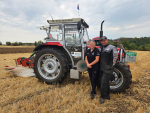
NZ Ploughing Team to Use Borrowed Gear After Shipping Mix-Up
The New Zealand ploughing team to the world championship in Croatia next month will be banking on borrowed equipment as they seek glory.




 increase font size
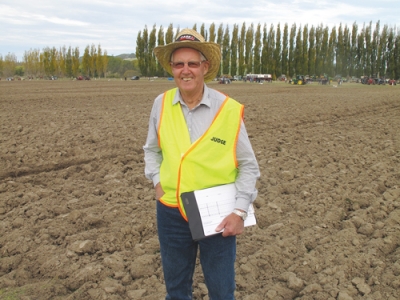 Alex Furniss.
Alex Furniss has only ploughed at one New Zealand final – Gore in 1966.
But he has since given a lot back to the sport, as a contestant and a regular judge or steward, since 1991 at regional events and NZ finals.
Furniss is also an authority on the rules and regulations on ploughing and recently updated the manual for organising and running a NZ final. He has been an executive member of the NZ Ploughing Association since 1999
“I have also been a member of the Waikato, Rotorua-Reporoa, Manawatu and Wairarapa Ploughing Match Associations, chairing organising committees or acting as secretary in the background making things run smoothly.”
During those years, Furniss was supported by his late wife Pam who was a newsletter editor and executive minutes secretary until 2005.
He started farming on the family farm at Huntly, then moved to 525ha at Reporoa, of which 400ha was covered in ti-tree. He then returned to Huntly, fattening sheep and beef and breaking in more land.
Furniss had a dairy farm at Galatea for
10 years, then farmed 405ha of wet hill country in the Pohongina Valley, breeding Romneys
and Angus.
His last property shift was to buy the southernmost farm in the North Island – Kawakawa Station at Cape Palliser. “We could see Wellington Heads and we were actually further south than Blenheim on an east west line.”
The farm was 2025ha plus a further 400ha of leased land. However, only a third of it was able to be farmed and it was divided into seven paddocks.
The land was steep going from sea level to 616m and was very dry, so no chance to fatten any stock, he says. “Winds of 100km/h were just a gentle breeze.”
In those days the Furniss’s started farmstays, B&B and two-day farm walks – out and back with accommodation and meals supplied and luggage transported.
“We got up to 150 trampers per season, mainly New Zealanders. Our son and daughter-in-law, who now run the farm, have expanded it to a three day tramp.”
Furniss, now 70, has remarried and with wife Christine lives in Masterton. Both are still active in the New Zealand Ploughing Association.
The New Zealand ploughing team to the world championship in Croatia next month will be banking on borrowed equipment as they seek glory.
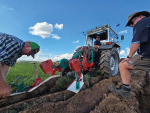
Ploughing champions Mark Dillon and Malcolm Taylor earned the right to represent the country at the World Ploughing Championships in Osijek, Croatia, on 5 and 6 September, after winning their titles at the New Zealand Ploughing Championships in Middlemarch in 2025.
Sean Leslie and Casey Tilson from Middlemarch, with horses Beau and Dough, took out the Rural News Horse Plough award at the Power Farming NZ Ploughing Championships at Horotiu, near Hamilton, on April 13-14.
The mood is relaxed as father and son ploughmen Paul and Derek Houghton get some practice in, but when the national championship starts this Saturday it will be a different story.
With our own National Fieldays only few weeks away, Rural News took the opportunity to take a trip overseas – as a guest of Enterprise Ireland, which invited 190 guests from 19 countries – to look at Ireland’s own national event, locally known as The Ploughing.


Federated Farmers has welcomed new rural policies released by ACT, saying they align closely with its own election priorities.

Rural Contractors NZ says proposed changes to land transport rules for agricultural vehicles are a welcome response by the Government to out of date regulations which have seen members hit with huge fines.
Alliance is calling for final applications for its 2027 Graduate Programme, with applications closing on Sunday 25 October.
Decades piloting planes has ensured vet and farmer David Hayes is focused on safety. So, after a serious accident while welding on farm, he is sharing his experience so others can learn from it.
Canterbury milk processor, Synlait Milk has confirmed Leon Fung as its chief executive officer.
OPINION: Making it easier to collect rainwater and use it to grow crops and livestock is a no brainer.



OPINION: The same mainstream media muppets that brought you Jacindamania in 2017 have been flat out pimping for the Opportunities…
OPINION: Your old mate reckons the atrocious way farmers in the UK are treated by their lords and masters in…




