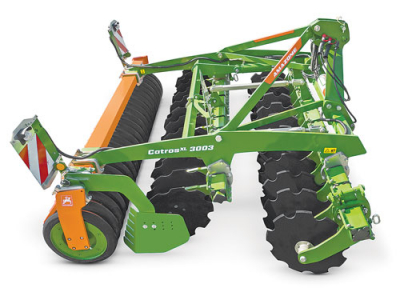
Amazone has extended its range of Catros disc harrows with its heavy-duty linkage-mounted XL series.
Available in 3, 3.5 and 4m widths and equipped with 610 mm serrated discs, the cultivators are capable of working depths to 16 cm.
The XL series fills the gap between the Catros Plus and Certos trailed cultivators. The former is equipped with 510mm discs and working to depths of 14cm, and the latter has 660mm discs and capable of working down to 20cm.
Besides the increase in disc size, a wide row spacing and open frame design ensures passage of crop residue, making it ideal for incorporating heavy cereal, maize or potato stubble.
A disc stagger of 12.5cm and steep 17 degree angle of attack on the front row of discs and 14-degree angle on the rear row are said to achieve good incorporation of organic matter alongside the cultivation process.
Run 12 - 18km/h, the Catros XL achieves high work rates, and independent tests by the DLG in Germany showed fuel use of 4L/ha when cultivating to a depth of 6cm.
Working depth is adjusted via manual spindles or an optional hydraulic system, with a link arm connection between the first and the second disc rows to ensure both gangs work at the same depth.
Machines can be specified with coarse-serrated convex discs -- recommended for stubble incorporation -- or lightly-serrated discs to produce a finer seedbed at shallower depths.
Each disc assembly is mounted to the shank via a maintenance-free, oil-immersed bearing. Meanwhile, each shank is mounted to the frame with a solid rubber mounting, in a design that has been proven over several hundred thousand operating hours worldwide.
The rear of the machine can be equipped with a choice of ten different rollers to ensure optimum soil reconsolidation in different operating conditions and soil types.