Fendt 900 Vario Marks 50,000 Units With Anniversary Edition
Fendt's 900 Vario was unveiled at Agritechnica 1995 and has since gone on to become a popular choice for farmers and contractors worldwide.




 increase font size
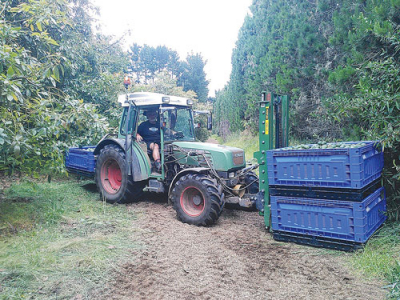 Reliability is one of the key reasons Northland farmer Ivan Stanisich favours Fendt tractors.
Northland farmer Ivan Stanisich has a herd of 215 milking cows, a 40ha avocado orchard and in his spare time is developing another 37ha of avocados.
The two Fendt 200 series tractors on the property – a 10-year-old 209P and a 2017 211P – are big enough to power PTO implements and lift silage bales, but small enough to fit under avocado trees and between the rows.
The farm manager who runs the dairy side of the business now uses the older one, and Stanisich has laid claim to the new machine.
Reliability is essential because the property is 180km north of service centres in Whangarei and 27km north of Kaitaia. After a decade with the 209P, the decision to buy the 211P wasn’t too hard, given the former’s reliability and durability.
Stanisich bought the second tractor to work the expanding avocado acreage and because he liked its vario transmission that allows stepless speeds from 20m/h up to 40km/h.
“The vario is good for trenching, root pruning in pine shelter belts and heavy mulching, due to the range of speed available,” Stanisich told Rural News.
“Particularly good are the 40km/h road speed at 1700rpm and PTO speed delivered at 1900rpm, which combine to offer fuel savings.”
At 1.7m wide, the newer 211P delivers 111hp -- plenty of power to drive a 3.0m mower, the 2.5m mulcher and a 1.75m forestry mulcher for orchard and general farm work.
Fitted with linkages and PTO front and rear, the tractor runs a front-mounted mower to allow a silage crop to be taken from between the avocado trees.
The orchard has been planted over a long time: earlier areas at 7.0m row spacing and more recent closer, so the tractors operate in spaces from 5 to 8m wide.
Manoeuvrability is said to be better than a quad: the tractor comes out of one row and turns back into the next.
Employed staff make safety rules paramount, e.g. warnings to apply the handbrake when leaving the cab, or indicating the PTO is still running.
The comfort of an air suspension seat and front suspension system are appreciated, as is the roomy cab, given that Stanisich is 1.8m tall.
Although the compactness of the 211 makes for little room under the hood, daily service items are readily accessible and easy to replace, and the space is not too hospitable for starlings.
Reliability is tops for Stanisich, hence his choosing the premium German brand; the seasons allow only a short window of time to do the work so breakdowns are a no-no.
Fendt's 900 Vario was unveiled at Agritechnica 1995 and has since gone on to become a popular choice for farmers and contractors worldwide.
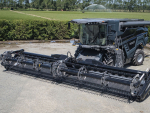
Ashburton based Carrfields has announced its appointment as the new authorised Fendt IDEAL combine harvester dealer across New Zealand with immediate effect.
Last month's Agritechnica event led to a wide group of manufacturers celebrating successes when the 2026 Tractor of the Year Competition winners, selected by a panel of European journalists, were announced in Hanover Germany.
ACGO showcased a one-of-a-kind golden Fendt tractor at the US Capitol in early August, commemorating the Great American Farmers Market, a week-long celebration of food, family and farming.
Released in New Zealand earlier in the year, the new Fendt 600 Vario series, serving the 150-200hp category, is a compact and manoeuvrable 4-cylinder tractor with high performance and payload, at a low power-to-weight ratio.


A team effort that is paying dividends for the wider New Zealand economy.
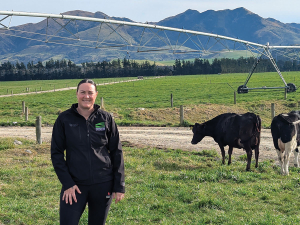
A strong sense of community involvement is what propelled the Federated Farmers' North Canterbury president Bex Green to the honoured title of the Feds' Advocate of the Year 2026.
The country's second largest milk processor is warning against 'complacency' during a review of competition regulations in the dairy sector.
Oamaru-based livestock handling specialist Te Pari has bought Combi Clamp, the New Zealand manufacturer of Combi Clamp manual sheep handlers.
Agriculture Minister Todd McClay has admitted that a scheme bringing workers from Pacific nations to work on orchards has become too hard to navigate but says changes are coming.
A new app designed in New Zealand aims to help sheep, beef and deer farmers capture, analyse and use body condition score data more effectively.


A fair question has been raised about how member-funded organisations should conduct themselves when taking a public position on any…
OPINION: It really is getting harder to lampoon government bureaucrats when they do such a good job of it themselves.…