Taking both the Fieldays Innovations Launch and the Locus Research Innovation Awards, the BioFume Ozone System shows early promise for cleaning and bacteria control.
Central to BioFume is the thunderstorm ‘clearing -the-air’ chemical reaction brought about by oxygen molecules becoming ‘supercharged’ by electrical discharges during a lightning storm; this causes three oxygen molecules to combine to form ozone.
Over time, the third molecule, which is not fully bonded to the others, breaks away and acts as a natural cleaner that when in contact with an odour (a volatile organic compound) reacts so as to oxidise the odour into a harmless, non-odorous substance.
Ozone also acts as a sanitising agent, killing all bacteria, pathogens and viruses, including E-coli and MRSA. Said to be 3000 times more effective at bacteria destruction than chlorine, the process has no harmful effects and leaves no residues.
Biofume Ltd of Mount Maunganui has developed a unit that harnesses this natural phenomenon and develops systems for horticulture and agriculture, including plant disinfection, water purification and bird deterrence.
Ozone is said to have a positive effect on soil, as it appears to improve percolation, delivering more oxygen to root systems which promotes root mass and depth. It is also said to help release soil-bound nutrients, cutting water use by up to 15%, and fertiliser need by up to 30%.
The Biofume ozone units are much smaller and more efficient than other similar units. They comprise an oxygen concentrator which purges nitrogen from the air and delivers a high-level oxygen stream to the ozone generator; the flow passes through a dryer to remove moisture, before going through a corona discharge system.
This is in effect a lightning generator which discharges a high voltage arc, similar to the ignition coil in a car, causing concentrated oxygen to break down to ozone.
In horticulture, for example kiwifruit, to kill bacteria or fungus a patented delivery system has the ozone delivery line plumbed into the suction side of the sprayer pump, where it is drawn in through a venturi for incorporation before it passes to the sprayer nozzles for application. This layout eliminates the need to ozonate a full sprayer tank of up to 2000L, and is a much smaller plant for the ozone generation itself.
Ozone not only controls bacterial and fungal attacks, it also benefits plant health leading to increased growth rates and denser crop canopies.
When ozone is used to repel birds it follows the principle of miners taking canaries down mines to detect noxious gases. In use, an ozone feed is fed to the highest point of a building such as a dairy shed or storage warehouse, from where it falls harmlessly to the ground. Large retail stores such as supermarkets are said to be reporting success with the concept.
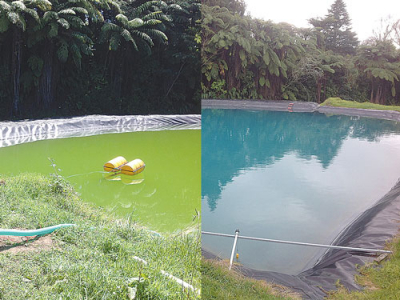
Likewise, ozone can be injected into a water source, where it kills fungus or bacteria by a cell-wall corrosion, effectively preventing them from reproducing and multiplying; this is ultimately the cause of water discolouration.
This occurs 3125 times faster than treating with chlorine-based products.
Trials by a large beetroot grower/packer in the Gisborne area have seen the device used for removing beetroot juice from the output of the washing plant.