South Island Agricultural Field Days gets new admin building
A brand-spanking new administration building will greet visitors to this year's South Island Agricultural Field Days (SIAFD) at Kirwee.




 increase font size

SEVERAL EXHIBITORS at the recent South Island Agricultural Field Days, Lincoln, were supported by manufacturers who’d flown half-way round the world to support their products.
Richard Flach of UK firm FLR Crop Drying was on Gough Agritech’s stand to support FLR’s hardwood drying floors. “They’re ideal for grass seed and a whole range of other crops,” Flach told Rural News.
Kiln-dried wood means there’s no risk of shrinking leaving gaps for air to escape causing uneven drying or, worse still, warping, which can happen with cheaper alternatives, he warns.
“If a floor like this does twist up you’re going to catch it with the [loader] bucket and do a lot of damage. That’s why ours are kiln-dried and we can show the certificates to prove that. Not everybody who says their floors are kiln-dried can,” he notes.
But Flach’s take-home message was to make sure the temperature of recently harvested grain is steadily reduced, starting from the day or night it comes into the store.
“You need to be onto it straight away to minimise the risk of insect infestation and keep going [with cooling] through the autumn. Ideally you should get it down to 5 degrees by winter. Historically, 10oC used to be the recommendation but people found they were still getting infestations at that because the bugs generate their own heat once they get going, so you really need to aim for five.”
While OP products such as Actellic are still available to protect grain from insect infestation here, in Europe they’ve been banned and Flach believes producers here should be using cultural methods such as cooling to minimise use.
Sprayer and other assorted equipment importer Talbot Agriculture had Clive Rische of Sands Agricultural Machinery (SAM) providing expert technical support on its stand.
“What we aim to do with our sprayers is provide simplicity for reliability,” Rische told Rural News. “We’ve not gone to having everything electric. We use hydraulics and air instead.”
Several other manufacturers who had gone to all-electric operation have since followed suit, he notes. “What it means is the owner or operator, assisted by someone on a phone call, can fix most problems themselves.”
Self-propelled sprayers have become the norm for larger-scale growers in the UK and SAM has about 30% market share, says Rische. “And we’re more active in export markets than our competitors.”
They’ve been supplying New Zealand since 1990 with Talbot Agriculture as the official agent since 2002, a couple of years after the Talbots bought their first SAM machine.
“We’d been using two tractor-mounted sprayers with front and back tanks before that but when it got wet we couldn’t get on,” explains Jeremy Talbot.
In the 98/99 harvest that cost them “just on 3t/ha” across their wheat area as they were unable to control BYDV-transmitting aphids, with the disease subsequently slashing yields compared to those of a near neighbour who, with a self-propelled machine, had been able to get on.
“Whether it’s pests like aphids or a fungal disease like rust, you need to be able to spray your wheat area in a three-day window, regardless of the ground conditions,” says Talbot, with hindsight. “It’s not so much a question of can you afford one of these, as can you afford to be farming without one?”
The SAM’s equal weight distribution over front and back axles and low ground-pressure tyres mean “you can spray a paddock when you wouldn’t even walk across it,” he adds.
A brand-spanking new administration building will greet visitors to this year's South Island Agricultural Field Days (SIAFD) at Kirwee.
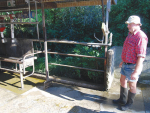
The roads to the south have mostly reopened but the uncertainty remains for the dairy farmers of Kaikoura following the November 14 earthquake.
Generators are being organised for dairy farmers in the upper South Island so that they could milk cows, says Federated Farmers North Canterbury Dairy chairperson Michael Woodward.
DairyNZ chief executive Dr Tim Mackle says while farmers in the North Island have taken a hit from the weather, in the South Island the dairy season started well.
Southdown breeder Chris Medlicott says farmers too often focus on the price per lamb instead of the return on kilograms of dry matter eaten.

OPINION: Farmers around the country are welcoming the proposed reform of local government.
A move to boost farmer uptake of low methane emitting sheep is underway.
Silver Fern Farms has tackled the ongoing war-induced shipping challenges to mideast markets by airlifting 90 tonnes of chilled New Zealand lamb and beef to the United Arab Emirates.
The primary sector is leading New Zealand's economic recovery, according to economist and researcher Cameron Bagrie.
Dairy industry leader Jim van der Poel didn't make much of the invitation he received to the recent New Zealand Dairy Industry Awards in Rotorua.
Farmers around the country are going public big time, demanding their local district, city and regional councils come up with amalgamation plans that meet the needs of rural communities and don't allow urban councils to dominate.


OPINION: The old saying 'a new broom sweeps clean' doesn't always hold up, if you ask the Hound.
OPINION: This old mutt went to school to eat his lunch, but still knows the future of the country, and…