Kuhn Group Sales Dip 9% in 2025 but Orders Signal Recovery
Kuhn Group recorded net sales of NZ$2.27 billion in 2025, finishing around 9% lower than in 2024.
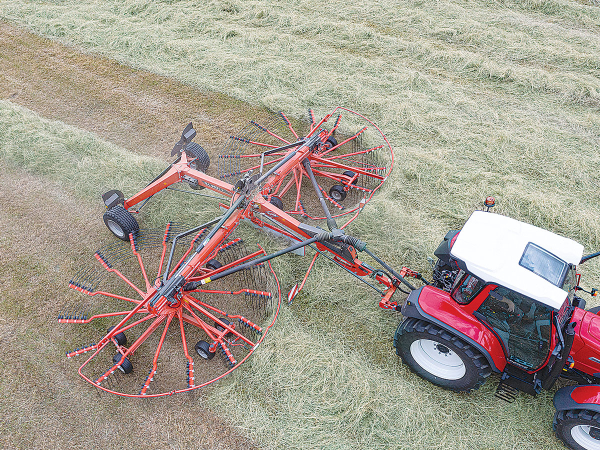
Kuhn’s new Gyrorake GA 8731+ and GA 9531+ models are described as “large width” semimounted rakes with central delivery.
Grassland specialists Kuhn has extended its Gyrorake offering with the addition of the GA 8731+ and GA 9531+ models.
Both models are described as “large width” semi-mounted rakes with central delivery.
Simple and practical to use, the machines offer raking widths from 7.7– 9.3 metres. This makes them suitable for both contractors as well as for medium and large farms wishing to increase throughput of round or large square balers and forage harvesters.
Offering the ability to deliver adjustable swath widths from 1.4–2.3 metres, the GA 9531+ model uses 15 tine arms on its four metre diameter rotors. This allows operators to group two windrows of straw behind combine harvesters equipped with cutting widths up to 7.5 metres.
Utilising well proven features from the extensive Gyrorake range, the rotor drive features a double reduction via the Master Drive GIII gearbox. This has a proven record of robustness in all conditions.
The GA 9531+ model features six wheels per rotor. This incorporates a tandem axle for superior ground following on all types of terrain – working in conjunction with 3-D articulation – alongside increased stability at higher speeds.
The rakes are designed to offer simple adjustment of the working or windrow width and the raking height – with the latter able to be done hydraulically. The Stabilift system locks the rotors in the windrow clearance phase, maximising ground clearance during headland turns. It also helps maintain a low centre of gravity and increased stability, particularly on slopes, while also locking the rotors during transport for increased safety.
www.kuhn.co.nz
New Zealand dairy farmers are set to be the first in the world to receive access to a new digital physical milk pricing tool that enables them to fix the price for their physical milk.
State farmer Pāmu is opening its farm gates this summer in an effort to give the rural sector the opportunity to see how large-scale, multi-system farming is delivering productivity and profitability across New Zealand.
A five-year study has found that the cost of reducing emissions without technology may be significant and unsustainable for Northland dairy farmers.
DairyNZ says Waikato farmers need certainty on Plan Change 1, but they say that certainty must be matched with practical, workable rules and a clear transition that doesn't get ahead of the new resource management system currently under review.
While the Government has moved quickly to make commercial hauliers' lot easier during the current fuel crisis, they appear to be stuck in the creep box when it comes to the agricultural industry.
Waikato farmers have been told that the Government’s new planning system legislation and the region’s Plan Change 1 (PC1) “won’t mesh together very well”.

OPINION: Central Hawke's Bay farmer Mark Warren recently told the Hawke's Bay Times it's time for a conversation about allowing…
OPINION: A nation that relies as heavily as NZ does on functional global shipping lanes will have to do its…