
Federated Farmers Backs Year 11 Agricultural Science
Federated Farmers is backing Feilding High School’s call to keep Agriculture and Horticultural Science as a standalone subject in Year 11.




 increase font size
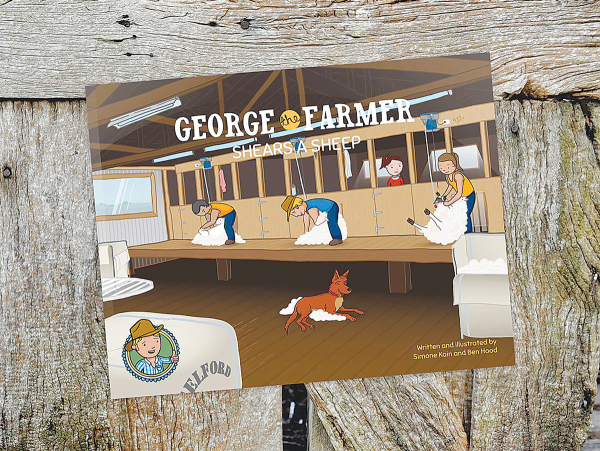 The ‘George the Farmer’ books explains to students more about where food and fibre comes from.
Forty-five primary schools across New Zealand will soon be better equipped to teach students about where food and fibre comes from.
These schools have all won ‘George the Farmer’ book sets in a recent competition by agri-lending specialist Rabobank.
They were asked to provide a brief explanation on why they should receive a set of the books. Several urban schools said that they would help build students’ understanding on a topic they know little about, while some rural schools thought that the books would help build pride among pupils from farming families.
Back in 2012, South Australia farmer Simone Kain was looking for farming books and apps for her farm obsessed son George. She quickly discovered that there wasn’t a global human farming character telling sequential stories for children about life on the land.
Thus, in 2014 the ‘George the Farmer’ book and education resource series was born. Over the next nine years, more than 100,000 Aussie kids have connected to the earth, food and farm through the adventures of George, his agronomist wife Dr Ruby and their twin children Lucy and Jack.
The books have also been garnering attention outside of Australia, with stockists in the US and Canada selling the brand over the past nine months and retail sales in many countries, including the UK, Hong Kong and New Zealand.
Attracting nearly 250 entries, the competition’s winning NZ schools were announced in late September, with the sets – featuring six ‘George the Farmer’ books covering different agricultural sectors – to be delivered early in term four.
Each book is connected to a set of learning resources which teachers can access online. Additionally, with help from Kain and the New Zealand Agribusiness in Schools programme. Seven NZ-specific learning resources with a variety of activities from Year 1-5 students have been developed and are now available on the Agribusiness in Schools website.
Rabobank Upper North Island client council chair Donna Arnold said the bank’s network had developed the competition with the aim of improving knowledge about farming and food production among young Kiwis.
As well as the book competition, Arnold says the network has also been developing other recent activities to improve understanding of food production and highlight agri sector career opportunities.
Federated Farmers is backing Feilding High School’s call to keep Agriculture and Horticultural Science as a standalone subject in Year 11.

Pāmu has welcomed Taranaki student Paige Burston as its newest First Foundation Scholar, supporting her journey towards a career in agriculture and animal science.
Kaikōura families affected by July's severe storm have found a practical solution to a problem that's kept some children away from regular schooling for weeks: a washed-out section of Inland Kaikōura Road, which has stopped the local school bus from running its usual route.
Special courses for secondary school teachers to help excite kids about agriculture and horticulture are now being run at Massey University.
The Government has announced a new rural scholarship designed to back emerging primary sector leaders.


As part of its Election 2026 coverage, Rural News asked political parties how they would help pull the arable sector out of the doldrums. Here's what they said:
Farmers are being encouraged to rethink how they manage waste on farm with the launch of ruralwastesorted.co.nz, a new website bringing together practical tips, real farmer experiences and resources.
New Zealand Winegrowers (NZW) is celebrating the India-New Zealand Free Trade Agreement (FTA) coming into force today, bringing New Zealand wine improved access to one of the world’s fastest-growing economies.
New Zealand’s red meat sector has welcomed the India-New Zealand Free Trade Agreement taking effect, which removes India’s 33% tariff on New Zealand sheepmeat.
More than 95 per cent of New Zealand’s forestry and wood exports to India can now enter tariff free as the New Zealand-India Free Trade Agreement comes into force today.
Federated Farmers is backing Feilding High School’s call to keep Agriculture and Horticultural Science as a standalone subject in Year 11.



OPINION: The same mainstream media muppets that brought you Jacindamania in 2017 have been flat out pimping for the Opportunities…
OPINION: Your old mate reckons the atrocious way farmers in the UK are treated by their lords and masters in…




