
Fonterra CFO Andrew Murray Resigns
Fonterra Co-operative Group chief financial officer Andrew Murray has resigned to take up a role outside the dairy giant.




 increase font size
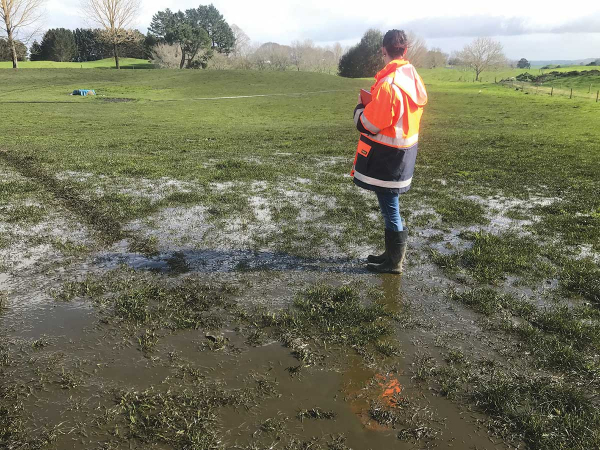 A Waikato Regional Council officer inspecting the extent of over application of effluent at the Trinity Lands farm
A large dairy farming operation, linked to Fonterra chairman Peter McBride, has been fined $47,000 for an effluent management breach.
South Waikato-based Trinity Lands Limited was convicted on one charge of contravening the Resource Management Act 199, filed by Waikato Regional Council.
McBride is the chief executive of Trinity Lands, but he wasn’t connected directly with the discharge of effluent from the Ronald Lion Farm, Tirau, in October 2019.
Judge Melinda Dickey convicted the company following a hearing in September last year and formally issued her judgement last week.
Trinity Land’s general manager Andrew Archer and contract milker Dirk Engelbrecht were discharged without conviction for their roles in the effluent breach. Both men agreed to pay council costs.
According to Judge Dickey’s sentencing notes, on 6 October 2019 at around 1.30pm, the council received a report from a member of the public advising of a green stream flowing into the Pokaiwhenua Stream.
Unable to access the stream, council staff inspected Trinity Lands’ properties bordering the stream.
On the Ronald Lion Farm, officers found the irrigator located in the paddock alongside the access road running through the Trinity Lands’ properties. Around the irrigator there were “large dark rings of effluent”, ten metres by ten metres, and ponding on the surface of the pasture.
On closer inspection, council officers noted that the soil was very wet and had been pugged recently.
“There was a strong dairy effluent odour present and obvious effluent accumulation on top of the soil,” Judge Dickey says.
“Council staff followed the effluent flow path along the sloped paddock towards a natural swale and down the slope to a nearby tributary. There was clear pugging and an accumulation of effluent and water in the holes visible down the length of the natural swale.
“During the inspection, the irrigator turned on and ran for between fifteen and twenty minutes. It remained stationary and its arms failed to turn for the period of operation.
“The effluent was observed pouring out the end of the nozzles with no fanning or distribution. The effluent accumulated on the ground prior to flowing down the natural swale towards the ponded tributary.”
Samples taken from the stream on October 6, 2019 revealed high levels of contaminants consistent with dairy farm effluent.
The court heard that the breach happened following the installation of a new effluent management system.
Trinity Lands’ lawyer Mark Hammond submitted that company has invested more than $5 million in effluent system upgrades, transitioning 16 dairy farms to a new effluent system. It has also built 16 new lined ponds and 12 large concrete weeping walls for solids separation.
Hammond also argued that contamination of the stream was limited but Judge Dickie didn’t accept the argument.
Judge Dickey found the company’s action careless and ruled that it must bear responsibility for the acts of its employees.
She noted note that at the time of the offending the company did not have in place documented farm protocols relating to effluent system operation and management.
“The parties do not need to be reminded that the matter of the appropriate disposal of effluent is a serious one,” she says.
“There are many cases where offending arises as a result of failings in the infrastructure and/or failings in the way in which that infrastructure is managed. Some of those incidents are unforeseeable, despite best endeavours to guard against discharges. Others are clearly foreseeable and the result of owners and/or operators taking risks.”
A few bad apples
Seven separate court cases against Waikato farmers and businesses have found that they each unlawfully discharged farm effluent into the environment.
The cases have been sentenced over the last three months, with the final case being made public last week, resulting in convictions and a total of $318,025 in fines.
The prosecutions were taken by Waikato Regional Council under the Resource Management Act.
Council regional compliance manager Patrick Lynch says the farming enterprises that feature in these seven cases reflect a very small portion of that industry.
"However, clearly there are still some in the industry who are not taking their environmental obligations seriously and continue to let the side down," he said.
"It is now well over 20 years since the current environment regulation has been in place to manage effluent in this region. I have no doubt that many will be disappiointed to see cases such as these still happening."
Fonterra Co-operative Group chief financial officer Andrew Murray has resigned to take up a role outside the dairy giant.

Four candidates have been confirmed for two director positions on Fonterra’s board.
A record farmgate milk price and strong global demand is laying the foundation for continued growth of organic dairy farming in New Zealand.
Waikato milk processor Tatua has again declared a record milk payout to farmer shareholders, leaving other processors in the dust.
Fonterra has unveiled its annual results for the 2026 financial year, posting $27 billion in revenue and close to $20 billion returned to New Zealand farmer owners and unit holders.



National’s pledge to introduce 19 new national standards shows the party is serious about getting Wellington out of farming, Federated Farmers says.
The National Party’s policies to make it easier to grow fresh vegetables, secure reliable water and energy and simplify farm planning are practical changes that will give growers the confidence to invest, according to Horticulture New Zealand (HortNZ).
Fonterra Co-operative Group chief financial officer Andrew Murray has resigned to take up a role outside the dairy giant.
A major move is about to get underway to improve the quality and viability of dairy beef and cattle in NZ.
Veterinarians say changes to the code of welfare for dairy cattle provides a positive foundation for improved cattle welfare across the country.
Today, 15 October, is the International Day of Rural Women, which recognises rural women’s contribution to farming, communities and the environment.





OPINION: The same mainstream media muppets that brought you Jacindamania in 2017 have been flat out pimping for the Opportunities…
OPINION: Your old mate reckons the atrocious way farmers in the UK are treated by their lords and masters in…




