Turning data into dollars
If growing more feed at home adds up to $428 profit per tonne of dry matter to your bottom line, wouldn’t it be good to have a ryegrass that gets you there quicker?




 increase font size
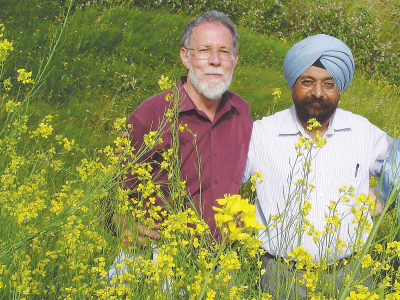 Professors Martin Barbetti and Surinder Banga with brassica crops.
A team led by Punjab Agricultural University, India, with researchers from The University of Western Australia, reports a breakthrough in disease resistance in brassica crops.
Brassica is an important genus of plants in the mustard family. Varieties commonly used for food include broccoli, cauliflower, cabbage, turnip and – especially – oilseed crops for producing canola oil and the condiment mustard.
The researchers claim their findings will lead to advances that strengthen crops against attack from Sclerotinia stem rot. This disease is particularly damaging to brassica crops such as canola and mustard, causing major yield losses worldwide.
The study, recently published in the journal Frontiers in Plant Science, describes genetic markers associated with resistance against the Sclerotinia stem rot disease in Brassica juncea (Indian mustard).
Professor Martin Barbetti from the UWA School of Agriculture and Environment and Institute of Agriculture says that managing Sclerotinia stem rot could be achieved by the genetic resistance present within brassica crops.
“Developing crops with greater disease resistance is the only effective avenue for long term, cost effective management of this devastating, worldwide pathogen.
“Our research has opened the way for deployment of the introgressed resistance genes from wild weedy Brassicas into a wide range of high-yielding cultivars, of B. juncea initially and, subsequently, into canola and other crop and horticultural brassica species.”
Barbetti believes this breakthrough has benefits for agriculture in NZ, Australia and India.
“Brassica juncea is the premier oilseed crop of India and has great potential for drier regions in Australia,” he explains. “This research will provide the opportunity to develop disease resistance in other Brassica crops, such as canola, the major oilseed crop in Australia and NZ.”
The study was supported by the Department of Biotechnology, Government of India, the Indian Council of Agricultural Research and The University of Western Australia.
If growing more feed at home adds up to $428 profit per tonne of dry matter to your bottom line, wouldn’t it be good to have a ryegrass that gets you there quicker?

When buying supplementary feeds, farmers need to consider the entire package on offer – service, freight and all the components in a feed mix – not just focus on the price of the cheapest component – palm kernel meal, according to J. Swap Stockfoods sales manager Joe Hardman.
Two high producing Canterbury dairy farmers are moving to blended stockfeed supplements fed in-shed for a number of reasons, not the least of which is to boost protein levels, which they can’t achieve through pasture under the region’s nitrogen limit of 190kg/ha.
OPINION: Few things are more stressful for dairy farmers than running out of feed when cows need it most.
Now is not the time to stop incorporating plantain into dairy pasture systems to reduce nitrogen (N) loss, says Agricom Australasia brand manager Mark Brown.


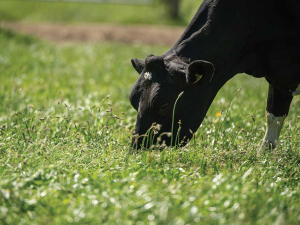
Farms across the upper North Island are trialling different pasture mixes as part of a research programme that aims to build greater resilience into farming systems.
Election years are always a concerning time for farmers, according to DairyNZ chair Tracy Brown.
The Ballance Farm Environment Awards are coming to the West Coast of the South Island.
Most dairy regions around the country have had a pretty good season so far says Tracy Brown.
Rural leader Mark Hooper has been appointed as an independent director to the NZPork board, bringing extensive farming, governance and advocacy experience to the role.


OPINION: The same mainstream media muppets that brought you Jacindamania in 2017 have been flat out pimping for the Opportunities…
OPINION: Your old mate reckons the atrocious way farmers in the UK are treated by their lords and masters in…