
It's The Margins That Matter
OPINION: It appears to be difficult for people who haven’t tried to run a business to understand the difference between assets and cash.




 increase font size
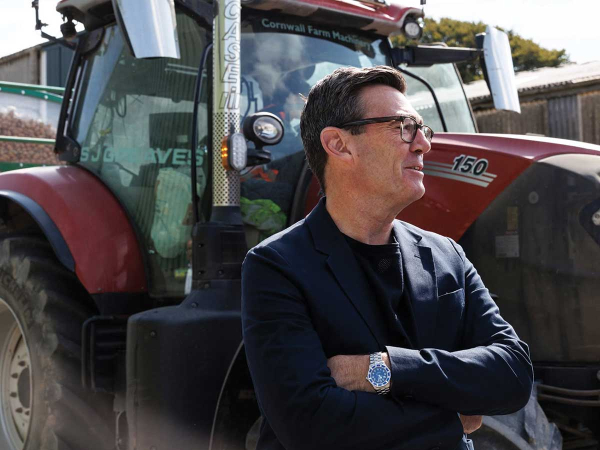 New UK Prime Minister Andy Burnham believes farming and food production must be spoken about in Whitehall at the same level as issues with ‘defence, energy, water and steel’.
OPINION: New British Prime Minister Andy Burnham has said that farming and food production is a matter of ‘core national resilience’ and must be spoken about in Whitehall at the same level as issues with ‘defence, energy, water and steel’.
The PM indicated the importance of the primary sector when talking to journalists after announcing the government’s drought relief support package of £65m for farmers hit by the drought.
He was then asked whether there would be increased funding for the Department of Food, Environment and Rural Affairs (Defra) in the next budget. Although he didn’t answer directly, he did say that “I do not think we can face the future in the same way we may have done in the past, where we just think, somehow magically food will arrive on everyone’s plate at a price that they can afford”. He also restated the intent to position farming and food production within core national resilience – “I think that should give you your answer”.
There are lessons in this for New Zealand.
Prominence and funding go hand in hand as society realises that the people working the land are important and need research in order to cope with the changes in climate, regulation and societal preference (affecting social license and consumption) that are being experienced.
The basic issue is food. It does not magically arrive.
For New Zealand it is also an issue of the economy, which then supports people to buy the food they need.
In an RNZ broadcast (now a podcast findable as ‘Our economic recovery: Want the good news or the bad news?’), Sharon Brett-Kelly explained the basics of the current economy. The message was that some parts of the economy are doing better than others, but that the good parts were having a positive effect on adjacent areas. “Primary industries are doing well and that’s filtering into South Island cities.”
Andrew Kelleher, the executive director of financial services company Shaw and Partners, calls it the proximity factor – proximity to primary produce markets.
In the rural sector we know about the money-go-round, where the farm income is then dispersed to employees and rural companies which in turn support others, including the supermarkets.
This message is not as clearly articulated in urban areas, where people’s first reaction (at least when asked by journalists) is that ‘food is too expensive’. However much leaders explain that domestic prices reflect the export prices (and then the cost of processing and transport and employment in the retail outlets selling the food and the rates and interest on the buildings…), ‘too expensive’ and ‘the cost-of-living crisis’ prevail. Yet when asked (sadly not since the end of 2022, and published in 2023), 70% of people agreed or strongly agreed that a farming-based economy is good for New Zealand. Only 8% did not – and they do tend to have loud voices.
It is the 70% that we can focus upon when talking about the importance of producing food and supporting the export economy.
Recent reports from BERL for beef and lamb, and Sense Partners for dairy, make the value of pastoral farming, through processing to export, clear. The reports show that processing employment in the primary sector has grown considerably, in contrast to the manufacturing sectors. “This long-run performance matters because processing jobs are generally higher paid and anchored in regional supply chains.”
In particular, ‘dairy is a large, regionally distributed, high-wage, export-intensive platform that supports a broad domestic supply chain and converts New Zealand’s natural advantage into durable national income’.
Farmers, rural professionals and researchers have created a competitive advantage globally. This advantage is already eroding because of lowering costs of production in some countries. It will be under threat if we don’t have the promised shifts in regulation to enable productivity gains, and ongoing research to create further productivity.
Both are vital.
The government is making progress with regulatory changes. As long as we keep explaining that on farm the changes are within environmental requirements and enable increased productivity, social license to operate will be maintained.
The government is also funding large research programmes with direct relevance to farming through the Ministry for Primary Industries. Programmes such as Resilient Pastures, and Dairy Beef opportunities, are under way, but what is also needed is the identification of drivers that have resulted in the apparent plateau in pasture productivity. Is drought, flood, heat or nutrient availability causing limitations? Or something else? Until scientists identify what is causing the problems, the promises made by developers of new technologies to do with, for instance, pasture management will not be realised.
By aligning food production with defence, energy, water and steel as core to national resistance, Andy Burnham has raised the profile of the importance of farmers and farming.
The world, including New Zealand, should do likewise.
Dr Jacqueline Rowarth, Adjunct Professor Lincoln University, is a farmer-elected director of DairyNZ and Ravensdown. She is also a member of the Scientific Council of the World Farmers’ Organisation. This email address is being protected from spambots. You need JavaScript enabled to view it.
OPINION: It appears to be difficult for people who haven’t tried to run a business to understand the difference between assets and cash.
OPINION: In the 1980s, concern was expressed in West Germany about the falling birth rate. Some simple analysis was performed by Professor Helmut Sies, physician and biochemist at Dusseldorf University. His letter ‘A new parameter for sex education’ was published in Nature in 1988:
OPINION: Humans are resilient. We are part of nature and have evolved for survival.
OPINION: Is New Zealand ‘Godzown’ or the ‘Last bus stop on the planet’?
OPINION: "The worst thing that agriculture does is take land from nature."


OPINION: There could hardly be a more appropriate theme for a conference than the one chosen by the red meat sector - Navigating Volatility.
When Northland leather worker Vernon Suckling started making horse saddles 50 years ago, quad bikes and side-by-side vehicles were unheard of.
Alliance Group has confirmed that eligible farmer-shareholders who supply and continue to back the business will receive up to $20 million later this year, following the strategic investment partnership with Dawn Meats.
With a general election under five weeks away, Rural News is asking major political parties about their policies and positions on key issues facing the primary sector. We will run their responses to each question over the next four weeks. The ACT Party and the Greens didn't respond in time.
The red meat sector is in great heart.
Entries opened on Monday, 5 October 2026 for the 2027 New Zealand Dairy Industry Awards (NZDIA), which organisers describe as the nation's biggest celebration of excellence in the dairy sector.





OPINION: The same mainstream media muppets that brought you Jacindamania in 2017 have been flat out pimping for the Opportunities…
OPINION: Your old mate reckons the atrocious way farmers in the UK are treated by their lords and masters in…




